Comparing research platforms
Maze vs. Great Question: Features, Pricing, and Use Cases Comparison
Maze is a Great Question alternative that helps companies build the right products faster by making user insights available at the speed of product development.


Maze vs. Great Question: Introduction
Choosing the right user research platform is a crucial step towards making better product decisions. Both Maze and Great Question are two options to help you gather user insights—but which is a better fit for your team?
Great Question is a multi-method UX research platform with a focus on interviews and research operations. It simplifies scheduling, recruitment, and panel management, while offering AI support for transcription, tagging, and summarization. Alongside moderated interviews, it also includes built-in surveys and prototype testing.
Maze is an AI-first, end-to-end research platform built for modern product teams. It brings qualitative and quantitative research into one workflow, helping teams gather insights at the pace of product development. The platform offers built-in participant recruitment, automated reporting, and a mobile app for cross-device testing. Maze AI supports the research lifecycle by helping teams plan studies, run interviews asynchronously through Maze’s AI moderator, and turn raw data into structured findings with summaries, themes, and tagged insights.
In this detailed comparison, we’re covering how both these platforms compare to each other in key points such as:
- User-friendliness: How easy will this platform be to onboard? Will it help scale and democratize user research in my organization?
- Versatility: Is this a true end-to-end platform? Does it facilitate the UX research methods I need? How well does this platform integrate with design tools we use?
- Product decision-making: How quickly can we collect and analyze reports? Will it speed up and empower stakeholder decision-making?
Platform comparison (from G2 reviews)
Maze | Great Question | |
|---|---|---|
Overall rating (G2) | 4.5/5 out of 100+ reviews | 4.7/5 out of 22 reviews |
Ease of setup | 9.4 / 10 | 8.9 / 10 |
Product direction | 8.4 / 10 | 10 / 10 |
Pricing |
|
|
Maze vs. Great Question: Main differences
What really sets Maze and Great Question apart for teams doing research?


Multiple research methods

Great Question is a UX research platform that supports live moderated interview studies, with panel management, a scheduling calendar, and automated participant incentives. It also offers unmoderated methods like surveys, prototype tests, card sorting, and tree testing.

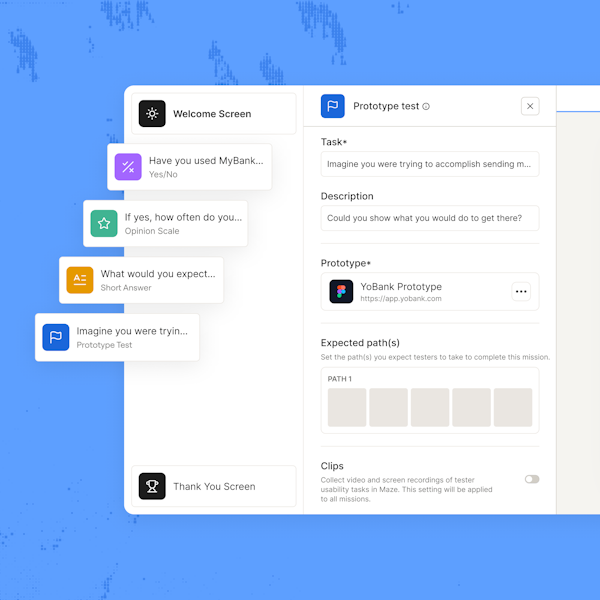
Maze is a complete user research and testing tool for both moderated and unmoderated studies—including interview studies, surveys, live website testing, prototype testing, card sorting, and tree testing. It also supports usability testing for AI-generated prototypes created in Loveable, Bolt, and Figma Make, giving teams a faster way to validate early concepts.


Insight management and repository

Great Question includes a built-in research repository with AI transcription, tagging, highlight reels, and an insights layer that lets teams tag, search, and reuse findings across studies.

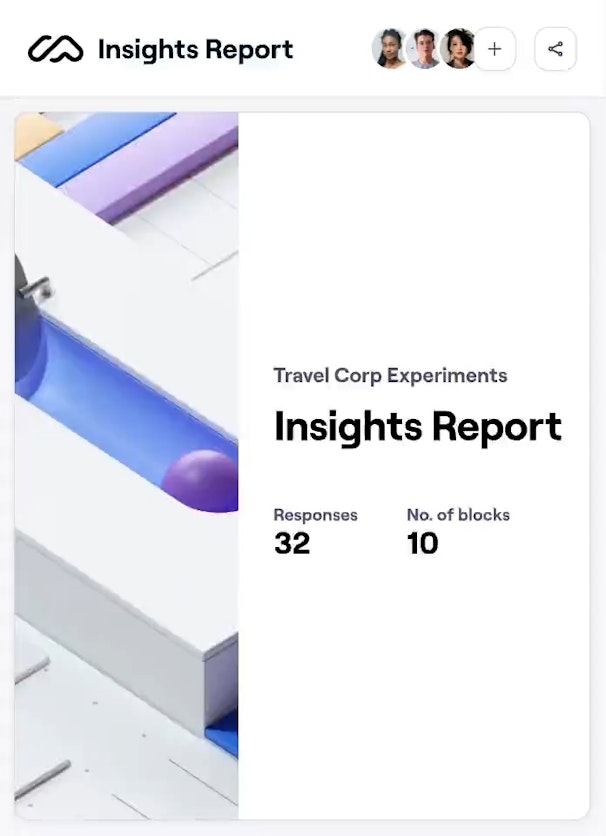
Maze includes automated, customizable reports and AI-powered analysis to transcribe interviews, identify sentiment, and tag key themes—giving teams a quick and scalable way to repurpose user feedback, track metrics, and share insights across the product lifecycle.


Maturity and scalability

Great Question is a relatively young platform (founded in 2021). It serves both smaller product teams and larger companies, but is still in its early stages.

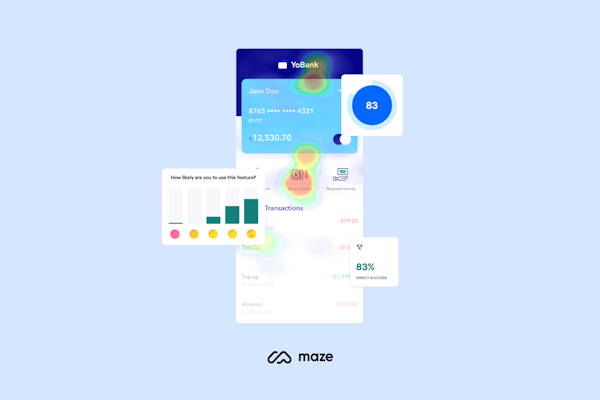
Maze is a trusted, enterprise-ready platform used by global product and UX design teams. With robust features, built-in integrations, and a proven ability to scale, Maze is built for organizations serious about continuous user testing and insight-driven development.
Maze vs. Great Question: Feature comparison
Features


Maze
—
—
—
—
Axure, Figma
Figma
Axure, Figma
Bolt, Figma Make, Lovable, Replit
—
Bolt, Figma Make, Lovable, Replit
Amplitude, Atlassian, Miro, Notion, Slack
Slack, Salesforce, Snowflake
Amplitude, Atlassian, Miro, Notion, Slack
Google Meet, Microsoft Teams, Zoom
Zoom
Google Meet, Microsoft Teams, Zoom
Maze vs. Great Question: Participant management & recruiting
Features
Maze
400+ targeting attributes
Not disclosed
400+ targeting attributes
150+ countries
Not disclosed
150+ countries
Maze vs. Great Question: AI capabilities
Features
Maze
—
—
—
![]()
Maze reduced the time and cost of running usability tests while allowing us to 10x our sample sizes. This efficiency and scale gives us much greater confidence in the precision of our metrics, all while keeping projects fast and more cost-effective.
Renato Leite
Head of CX Research Operations at Itau



Maze vs. Great Question: Takeaways
Whether you opt for Maze or Great Question depends on your approach to user research and your team’s needs.
Great Question was built to simplify moderated research, especially recurring user interviews, by automating recruitment, scheduling, incentives, and AI-supported transcription and analysis. It also supports surveys, unmoderated prototype tests, card sorting, tree testing, and AI-moderated interviews. However, it doesn’t offer experimentation features like A/B testing, in-product survey widgets, or first-click tests for teams that need continuous research or rapid UX validation.
Maze is built for teams that want research to move at the pace of product development. It combines moderated and unmoderated methods in one intuitive platform, with AI-powered reporting, flexible recruitment, and built-in participant management. Maze AI helps write study questions and interpret qualitative feedback from interviews and open-ended responses, while the AI moderator lets you run interview sessions you can trust. Maze gives teams a scalable way to do more research, more often, without adding more tools.
Why product and design teams are switching to Maze

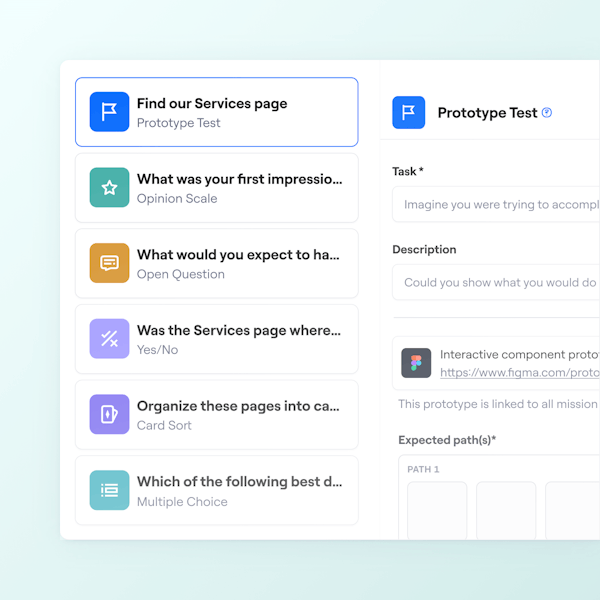
End-to-end research, ready out of the box
Run card sorting, tree testing, prototype testing, surveys, A/B testing, mobile testing, and moderated interviews in one platform. Maze supports continuous research from day one, helping teams move from question to insight without switching tools.

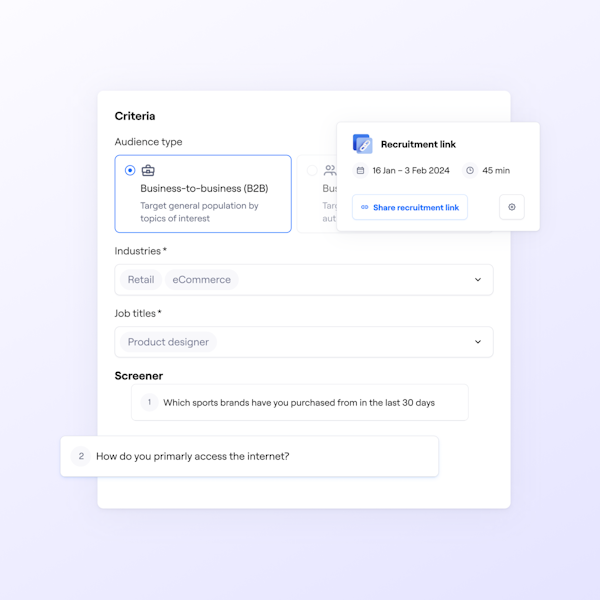
Seamless participant management
With Maze Panel, you can recruit from 6M+ global testers using 400+ filters, or manage your own participants with Reach, a built-in CRM. Advanced segmentation and targeting help optimize moderated and unmoderated research across desktop and mobile apps.

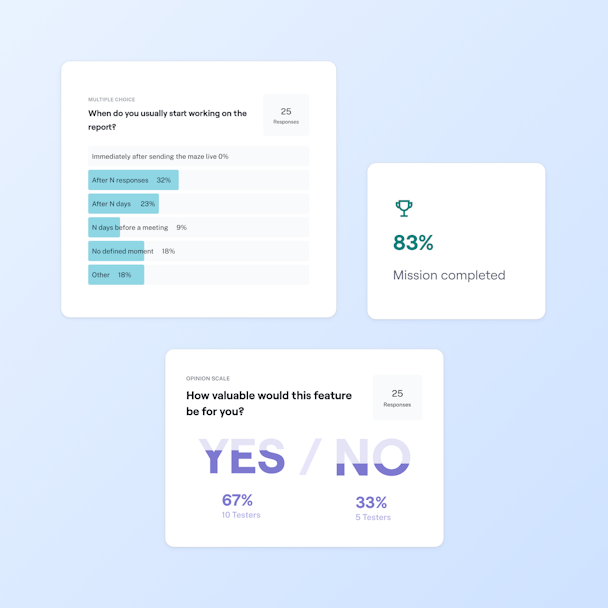
AI-powered analysis and automated reporting
Maze AI uncovers insights in your qualitative studies, like research summaries, key themes, and user sentiment. These insights are combined with findings from quantitative studies in automatically generated research reports—ideal for democratizing research and engaging stakeholders.



Maze vs. Great Question FAQs
Why choose Maze over Great Question for user research?
Why choose Maze over Great Question for user research?
Maze gives product teams a fast, experiment-friendly environment for both moderated and unmoderated research, including prototype testing, surveys, card sorting, tree testing, and live website and mobile testing, with built‑in recruitment and automated reporting.
While Great Question also supports multiple methods, it focuses more on interview operations, participant panels, and a central research repository. It lacks A/B-style testing and live product experiments, so Maze is often the better choice when continuous, high-volume product testing is the primary goal.
How can I start using Maze?
How can I start using Maze?
You can get started with Maze by signing up for a free account—no credit card needed. It’s a quick way to explore the platform and run your first study. If you’re looking for a tailored walkthrough or want to see how Maze fits into your team’s workflow, you can also book a demo with our team.
Can I switch from Great Question to Maze?
Can I switch from Great Question to Maze?
Yes! Maze supports both moderated and unmoderated research in a single platform, so you can consolidate your tools and your workflow. Our team can help you migrate studies, set up templates, and make the most of Maze’s built-in participant management and AI-powered reporting. If you’d like hands-on support, we’re happy to walk you through it.
Who is Maze for?
Who is Maze for?
Maze is built for product teams, UX researchers, designers, and anyone involved in making user-informed decisions. Whether you're part of a startup running lean tests or an enterprise scaling research across departments, Maze gives you the tools to collect insights quickly, collaborate easily, and deliver better experiences.
What kind of teams use Maze?
What kind of teams use Maze?
Maze is used by product, design, research, and marketing teams at companies of all sizes—from early-stage startups to global enterprises. It’s especially valuable for teams practicing continuous discovery, looking to scale research, or aiming to democratize insights across functions. Whether you're validating prototypes, testing live flows, or running interviews, Maze supports cross-functional teams working to build better products.
How do Maze and Great Question compare in AI functionalities?
How do Maze and Great Question compare in AI functionalities?
Maze offers a wider set of AI features than Great Question. Both support AI-moderated interviews, transcription, analysis, and summaries, but Maze adds project naming, question quality checks, phrasing support, survey theme grouping, and sentiment analysis. Great Question’s AI is centered mainly on interviews, while Maze applies AI across the entire research workflow.