


















TL;DR
User research is now treated as core business infrastructure. Our 2026 Future of User Research Report discovered that:
- 41% of teams say research informs both product and broader strategic decisions
- 22% consider it essential at all levels of business strategy
- Over half of teams track KPIs and OKRs tied directly to research impact
This shift shows that user research is no longer just helping teams improve usability. It’s helping them make sharper product bets, reduce the risk of building the wrong solutions, and connect research studies to business outcomes, from growth to efficiency.
User research has shifted from a supporting function to a strategic business driver that shapes where companies invest, what they build, and how they grow.
We surveyed nearly 500 researchers, designers, and product professionals for our Future of User Research Report to understand how teams use insights from user research to guide product and business decisions.
In this article, we highlight 20+ user research statistics that show how research drives revenue, reduces risk, and makes teams more efficient.


The importance of user research
Research is firmly claiming its seat at the table, and for good reason. These findings highlight the return on investment of user research and how it’s impacting business decisions and success.
1. 41% of teams now say user research informs both Product decisions and broader strategic business decisions. (Source)
When research shapes both Product and business decisions, its ROI becomes easier to see. Insights help teams prioritize the opportunities most likely to drive growth, avoid investing in the wrong segments or features, and focus resources on work that delivers customer and business value.
2. Companies that use user research to inform business strategy report 2.7x better outcomes than those that conduct research but rarely use it in decision-making. (Source)
When research informs business strategy, it becomes a decision engine, improving everything from product‑market fit to revenue and retention. It means leaders are making more evidence‑based calls, which compounds over time into stronger growth.
3. Organizations that use research to inform business strategy see 5x better brand perception, 3.6x more active users, and 3.2x better product‑market fit compared to those that rarely use research in decisions. (Source)
These numbers show that user research enables you to optimize how customers see your brand and how deeply they engage. When you ground decisions in real user needs, teams build products that people talk about, which is where long‑term ROI comes from.
4. Organizations with mature research practices are 1.9x more likely to report improved customer satisfaction. (Source)
Organizations with advanced research practices prioritize understanding customer needs through a variety of UX research methods and data sources—like in-depth interviews, usability studies, and more. They go beyond simply enhancing product usability—they deeply integrate research and user testing into every stage of the product life cycle, from initial product discovery to post-launch evaluation.
As a result, they are more adept at customer retention and increasing active user engagement, moving away from cost-saving outcomes to focus on value creation through continuous, customer-centric innovation.
5. Only 6% of teams say research is conducted but rarely used in decision-making, down from 13% the year before. (Source)
This suggests more teams are closing the gap between insights and action, turning user research from a cost center into a visible driver of roadmap decisions, business strategy, and ultimately ROI.
Trends and growing demand for user research
As competition intensifies, teams are under more pressure to release new products and features quickly. More organizations are investing in continuous discovery and using user research insights to decide what to build, how to prioritize, and where to place their biggest bets.
Let’s take a look at some of the UX research statistics defining user research trends in 2026 and beyond.
6. 66% of Product professionals reported increased demand for research, up from 55% last year. (Source)
As research becomes more visible across the business, demand for research is growing; teams are relying on it to de-risk decisions, validate direction, and show why certain product choices are worth pursuing. But demand is now outpacing capacity, which means research teams need better systems, clearer workflows, and scalable ways to support more requests without lowering quality.

7. 31% of participants say the researcher role is becoming increasingly strategic, with researchers playing a bigger role in setting strategy, influencing cross-functional decisions, and shaping business direction. (Source)
This shows that user research is moving beyond study execution. Researchers are increasingly expected to connect customer evidence to business priorities, help teams decide what to build next, and translate insights into direction leadership can act on.
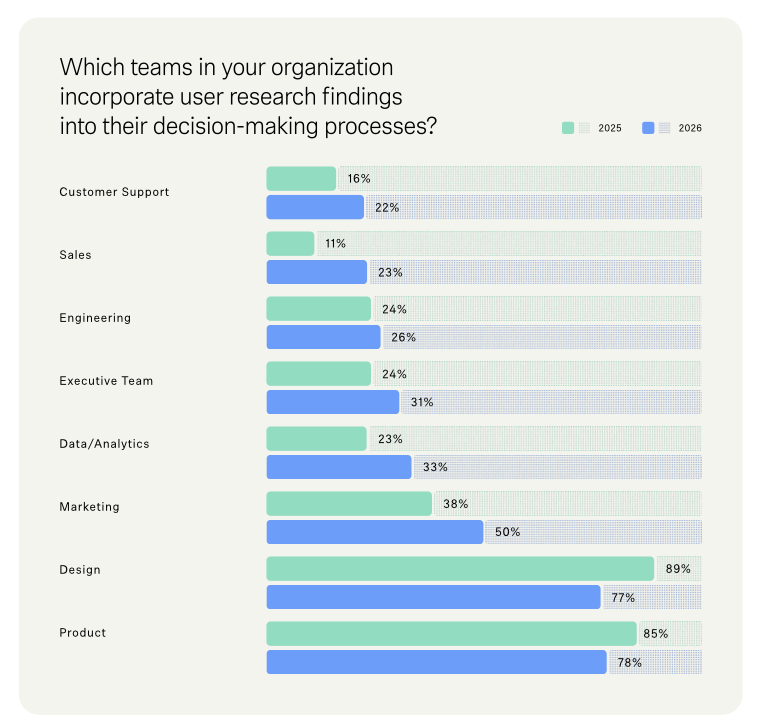
8. Marketing saw a 32% increase in incorporating research into decision-making compared to 2025, while customer support and executive teams are also using research more. (Source)
Research influence is spreading beyond Product and Design. As more teams use customer insights to guide decisions, research becomes a shared source of evidence across the organization. That broader adoption helps teams align faster and make more user-centered decisions.

9. Research-mature organizations achieve 2.3x better business outcomes. (Source)
Maze’s 2025 Research Maturity Model found that mature research practices are linked to business impact across areas like time-to-market, revenue, brand perception, retention, and product-market fit.
10. High-maturity organizations are 5.1x more likely to conduct generative research and 1.8x more likely to conduct research frequently. (Source)
The same report found that mature organizations use research earlier and more often. In the same report, high-maturity organizations are shown to use generative research to identify customer needs, explore problem spaces, and identify new opportunities before solutions are already defined. They also make research a more frequent habit across roles, helping teams move from one-off validation to ongoing, user-centered decision-making.
Benchmark your research maturity
Explore Maze’s 2025 Research Maturity Model to see how mature research practices help teams scale insights, improve business outcomes, and build a stronger case for research investment.


In our 2026 Future of User Research Report, 22% of organizations now say research is essential at all levels of business strategy, signaling that more teams are moving toward the highest level of maturity.
Popular user research methods and workflows
Most teams rely on a familiar toolkit of mixed methods to understand their users, then adapt their workflows based on the question, timeline, and level of risk involved. Teams also use methods like card sorting and tree testing to evaluate information architecture, understand users’ mental models, and identify where navigation or content structure may create user frustration.
As user research becomes more embedded in product development, these methods are showing up across the lifecycle—from early discovery through validation and post‑launch learning.
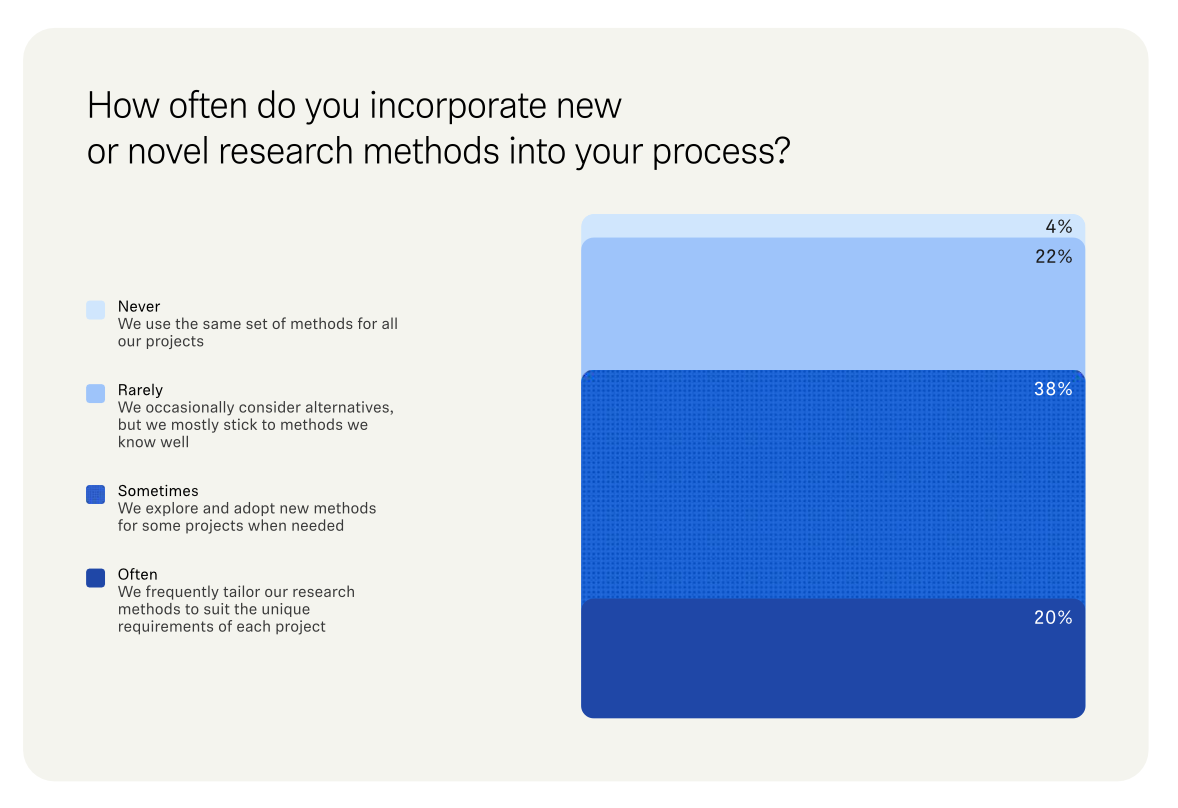
11. 38% of teams say they sometimes explore and adopt new research methods for specific projects, and 20% frequently tailor their methods to unique requirements. (Source)
Rather than relying on a fixed playbook, many teams now adjust their methods based on the question, timeline, and risk level, signaling a shift toward more flexible, context‑aware research workflows.

12. While surveys (77%), usability testing (75%), and moderated interviews (71%) remain core methods, 21% of teams are already using AI‑moderated interviews.(Source)
Traditional methods still anchor most research programs, but teams are starting to layer in newer formats, like AI‑moderated sessions, to increase speed and volume without relying solely on live moderation.
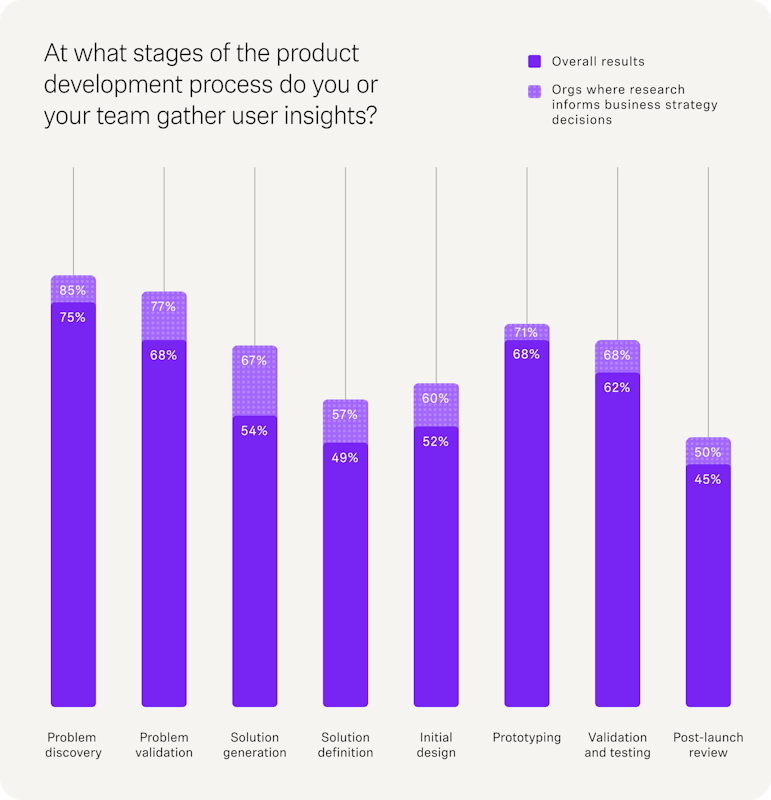
13. User research is most commonly conducted during problem discovery (75%) and problem validation (68%), with fewer teams (45%) conducting research at post‑launch review. (Source)
Most teams front‑load research early in the process, but fewer close the loop after launch, which means they risk missing insights that come from real‑world usage and long‑term behavior.

14. 89% of Design teams and 78% of Product teams are using research insights to inform their decision-making workflow. (Source)
And it’s not just them. Marketing (50%), Data/Analytics (33%), Executive (31%), Engineering (26%), Sales (23%), and Customer Support (22%) teams are also incorporating user insights into their decision-making. The research workflow is expanding to include more teams.
15. Marketers (23%), data analysts (19%), customer success managers (10%), engineers/developers (8%), and sales reps (7%) are increasingly conducting user research. (Source)
Alongside an increase in teams using research to inform their work, we’re also seeing more teams than ever conducting user research. They’re using established methods and workflows to incorporate user research into their decision-making process, joining UX researchers in the pursuit of valuable insights.
Challenges facing Product and Research teams
From limited time and recruitment hurdles to gaps in enablement and executive support, user research still faces numerous challenges within organizations.
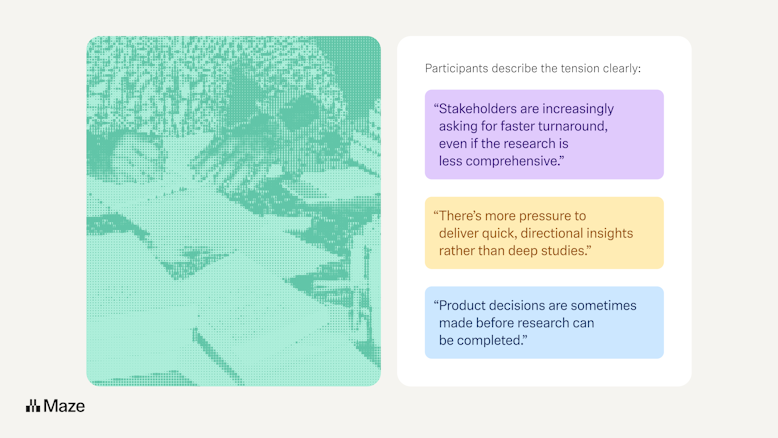
16. As demand rises, many teams describe pressure to deliver “faster, lighter” research, with stakeholders asking for quick, directional insights rather than deep studies. (Source)
Product timelines often move faster than traditional research cycles, so researchers are pushed toward rapid pulses that answer quick validation questions (for example, “Did users complete this task?” or “Is this flow confusing?”). Over time, this can create a pattern where research is treated as a speed bump rather than a strategic asset, increasing the risk of shallow understanding and rework down the line.
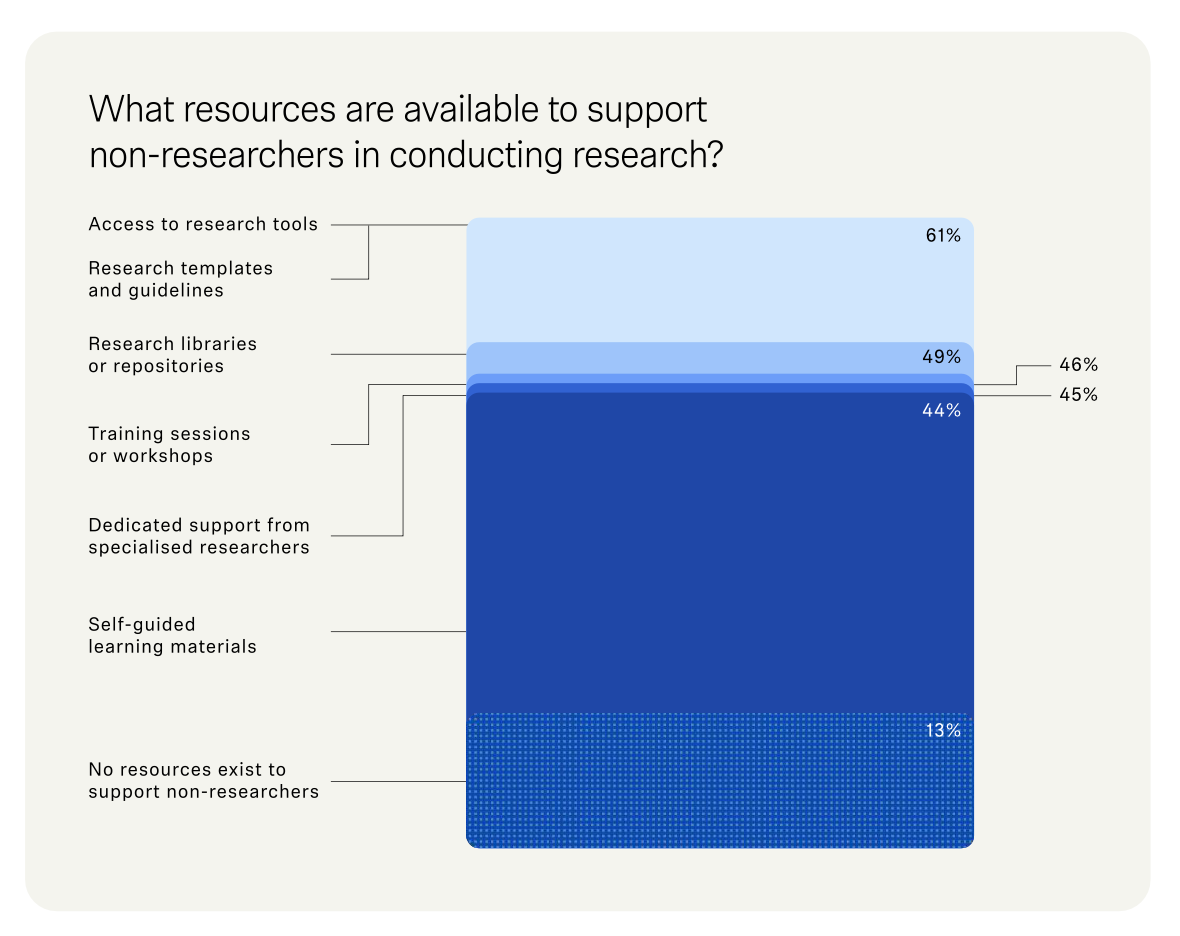
17. 61% of organizations provide access to research tools, but only 45% offer dedicated support from specialized researchers, 46% offer structured training, and 49% have research libraries or repositories. (Source)
Tool access has outpaced enablement, meaning many non‑researchers are expected to ‘self‑serve’ without guardrails on methods, quality, or ethics. This can lead to fragmented practices, duplicated work, and insights that are hard to trust or reuse because they weren’t produced with shared standards in mind.
18. 13% of organizations say they have no resources at all to support non‑researchers conducting research. (Source)
In these companies, anyone outside the Research team who wants to run a study is largely on their own—with no templates, training, or centralized knowledge to lean on. That makes it harder to scale research responsibly and increases the risk that important decisions are still driven by gut feel, even as demand for user‑centricity grows.

19. 63% of Product professionals say time and bandwidth constraints are their biggest challenge in doing user research, making it the top obstacle for Product teams. (Source)
Teams are juggling packed roadmaps, tight release cycles, and competing priorities, so even when everyone agrees research is important, there often isn’t enough capacity to do it properly. As a result, research either gets squeezed into unrealistic timelines or dropped altogether, which increases the risk of building features on assumptions instead of evidence.
20. 48% cite recruiting the right participants as a key challenge, and 30% struggle to recruit participants in time. (Source)
Finding people who truly represent your target users and getting them scheduled quickly is one of the most stubborn bottlenecks in the research workflow. When recruitment lags, teams either delay decisions, compromise on participant quality, or move ahead without enough input from the users who matter most.
21. 30% of respondents report difficulty getting executive buy‑in for user research. (Source)
Although there’s been an increase in executive buy-in for user research, many organizations still don’t prioritize research at the strategic level. When leaders don’t fully understand or trust the value of research, it shows up as limited budget, reduced headcount, and decisions being made without user input. This forces research teams into a defensive posture, constantly having to prove their worth instead of being brought in early as strategic partners.
AI adoption in user research
AI has rapidly become a standard part of many research workflows. Teams are using AI in UX research to speed up operations, handle repetitive tasks, and unlock faster insights—while still relying on human judgment to interpret results and make strategic decisions.
22. Nearly 2 in 3 participants (69%) now use AI in at least some of their research projects, a 19‑point increase from last year (up from 50% from 2025). (Source)
In just one year, AI adoption has gone from a differentiator to a baseline expectation, especially for roles that need to keep pace with fast product cycles.
23. In 2026, researchers report using AI to analyze data (76%), automate transcription (57%), plan and draft studies (56%), and generate research questions (55%). (Source)
The picture is consistent year over year. AI is not replacing researchers; it’s supporting them. Researchers use it as a force multiplier, letting the machine handle repeatable, pattern‑driven tasks so humans can stay focused on ethics and stakeholder influence—where human judgment matters most.
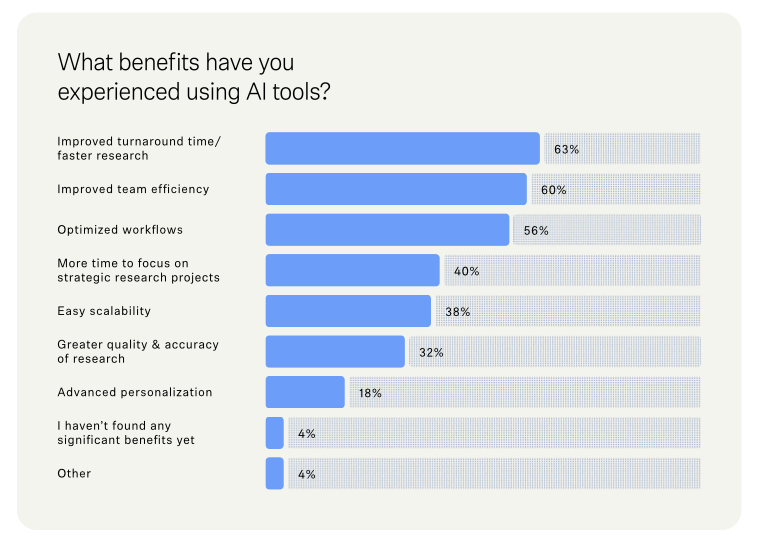
24. 63% of teams say AI helps them deliver research faster, while 60% report improved team efficiency and 56% say it helps optimize workflows. (Source)
The value of AI is in how it changes how Research teams operate. Faster turnaround times and more efficient workflows allow teams to support more stakeholders without increasing headcount.

25. 73% of teams say the need for human review is the biggest challenge when using AI, followed by trust and credibility concerns (66%) and ethical or privacy risks (43%). (Source)
While adoption is rising, teams are still cautious. AI is being treated as a support tool rather than a replacement, with researchers maintaining oversight to ensure accuracy, quality, and responsible use.
How Maze helps teams scale research
As demand for user insights grows faster than headcount and budgets, Maze is designed to help teams scale research and overcome research challenges.
Maze panel and participant management platform, Reach, make it easier to continuously reach the right users with every study. Once participants are in, teams can choose from multiple research formats, including interview studies, prototype testing, live website testing, mobile testing, and surveys, enabling teams to match the method to the question.
Plus, the AI moderator runs adaptive research conversations with participants. It starts with your study goals, asks unbiased questions, follows up based on what participants say or do, and helps teams understand the reasoning behind user behavior. Teams can use it across interviews, concept tests, prototype walkthroughs, and live experience testing, with support for visual stimulus testing, flexible discussion styles, and screen-sharing.
On the analysis side, Maze AI, automated reports, and video clips help synthesize findings faster and make them easier to share with stakeholders.
Maze turns research into an always-on, scalable practice, so you can join the 41% of organizations that use research to inform both product decisions and broader business strategy.
Frequently asked questions user research statistics
What is the ROI of investing in user research?
What is the ROI of investing in user research?
Teams that use user research to inform business strategy (not just UX design decisions) report up to 2.7x better outcomes across key metrics like revenue growth, product‑market fit, and customer retention compared to teams that rarely use research in decision‑making. They see higher product usability, stronger customer satisfaction, and more active users, which directly improves conversion rates and long‑term customer value.
What percentage of companies have a dedicated UX researcher?
What percentage of companies have a dedicated UX researcher?
82% of companies surveyed have at least one dedicated UX researcher. This shows that UX research is now a defined role within many organizations.
How does user research impact product decision-making?
How does user research impact product decision-making?
In our 2026 Future of User Research Report, 41% of teams said research informs both product decisions and broader strategic business decisions, while only 6% said research is conducted but rarely used in decision-making. This shows research is becoming a practical input for prioritization, roadmap planning, and deciding which opportunities are worth pursuing.
What are the biggest challenges teams face with user research?
What are the biggest challenges teams face with user research?
The biggest challenge is time and bandwidth, with 63% of respondents saying it’s their top obstacle. Teams also struggle with recruiting the right participants (48%), translating research into measurable business outcomes (42%), recruiting participants quickly enough (30%), and getting executive buy-in (30%).
When using AI tools, 73% of participants say the need for human review is a key challenge, alongside trust and credibility concerns (66%) and ethics and privacy concerns (43%). Additionally, 13% of organizations report having no resources at all to support non-researchers in conducting research, highlighting an enablement gap.
What are the most commonly used user research methods in 2026?
What are the most commonly used user research methods in 2026?
In 2026, surveys (77%), usability testing (75%), and moderated user interviews (71%) remain core, while about 21% of teams are already experimenting with AI‑moderated interviews as part of their research methodology to optimize speed and sample size without losing depth.
For example, Maze’s AI moderator guides participants through research conversations based on the study goal, then probes for more detail when responses need context. Teams can use it to evaluate concepts, prototypes, and live experiences. With visual stimulus testing, flexible discussion styles, and screen-sharing, the AI moderator helps teams capture feedback across various study types.