















TL;DR
Inclusive user research makes your product better and more ethical. Grounded in five core pillars—access, relevance, trust, recognition, and organizational mindset—it calls for inclusive practices across your research process, such as screen reader–friendly tools, asynchronous options, and inclusive task design.
When done right, inclusive UX research leads to accurate insights, improved usability, and a better product–market fit.
Decisions made during the research process, like how participants are recruited, what methods are used, or which tools are required, can unintentionally exclude people.
That might include participants who use assistive technology, speak different languages, have limited internet access, or navigate the world with different cognitive or physical needs.
Whoever it is you exclude, you do so at a cost to your product.
In this article, we look at what inclusive user research means in practice. We highlight common points of exclusion and share ways to build research practices that are accessible, representative, and more thoughtful by default.
To help shape this piece, we spoke with Geoffrey Crofte, Senior UX Lead and Accessibility Officer at Groupe Foyer and author of ‘What Designers Need to Know About Accessibility’. His work bridges design systems and inclusive practice, offering a clear and grounded perspective on what it takes to get inclusion right.
Why inclusive user research matters
Inclusive user research is the practice of planning, conducting, and analyzing research in ways that account for the full spectrum and intersectionality of human diversity.
This includes—but isn’t limited to—differences in ability, age, race, gender identity, language, culture, location, socioeconomic status, and tech literacy. It’s about ensuring that research sessions accurately reflect the diversity of the groups of people who use your digital products.
In practice, this means checking whether your screeners, research methods and materials, and tools unintentionally exclude people. It involves looking beyond the ‘average user’ to include voices that are often excluded from the research process.
“To me, being inclusive in UX research means being intentional, and I insist on being intentional about involving a wide range of people. Not just the ‘average user,’ but people with different abilities, backgrounds, ages, tech access, beliefs, identities, origins, and experiences.”


Geoffrey Crofte
UX Accessibility Author and Senior UX Lead
Share
The risks of skipping this step are real, and they impact your user.
“When we design research that only includes a narrow slice of people—oftentimes people who resemble us, because that’s how humans work by default—we miss out on new perspectives that are tremendously valuable in the conceptualization phases,” Geoffrey told us.
“And we risk building products that exclude or even harm others. It reminds me of the first Apple Health app. The first version didn’t include a menstruation tracking feature; tell me no women were involved in its design without telling me.”
Inclusive UX research leads to better product decisions grounded in user needs. And when you prioritize inclusivity in research and design, you often find that it benefits all users, not just the ones you had in mind.
Where and how exclusion typically happens in UX research
To prioritize inclusion, you need to recognize exclusion. Here are some of the most common exclusion points in inclusive user research, backed by research and best practices:
- Narrow recruitment criteria: Inclusive user research depends on recruiting participants who reflect your full user base, not just a segment that’s easy to reach. But many studies default to recruiting people who are digitally fluent, English-speaking, or based in urban centers. This skews results and excludes people with different accessibility needs, levels of digital literacy, or geographic and socioeconomic backgrounds.
- Biased screeners: Screener surveys are a common source of unintentional exclusion. For example, filtering for ‘professional’ titles might rule out unpaid caregivers or part-time workers. Using overly academic language or assuming a baseline tech setup can also screen out participants who would otherwise provide valuable insights. If your screener doesn’t allow space for neurodiversity, assistive technology, or flexible interpretations of identity, you’re likely introducing bias in UX research early on.
- Inaccessible tools or session formats: Many remote user testing sessions rely on fast internet, video conferencing, and specific devices—all of which can be barriers for participants with limited bandwidth, older hardware, or disabilities. If your user testing setup doesn’t support screen readers, captioning, or non-verbal participation, you’ll miss perspectives from people who rely on assistive technology or prefer asynchronous options.
- Scheduling and session logistics: Offering only weekday sessions during business hours can exclude working-class participants, caregivers, people in different time zones, or those with irregular schedules. Even requiring research participants to speak aloud can be a blocker for people with speech impairments or anxiety. Inclusive UX research means thinking beyond the 'standard' session and meeting users where they are.
- One-size-fits-all research methods: Some methods, like open-ended user interviews or fast-paced usability testing, can unintentionally favor confident, verbal, or neurotypical participants. Including methods like diary studies, surveys, or moderated sessions with extra support can help reflect a broader range of user needs.
Geoffrey Crofte, Senior UX Lead and Accessibility Officer at Groupe Foyer, shares a candid example of how exclusion can quietly take root, even with good intentions:
“I can’t speak for all designers, but I can share how we, at Foyer, unintentionally exclude people, simply through the way our process is set up.
“We created a ‘User Club’ made up of volunteer clients, recruited through our app and digital touchpoints. When it comes time to reach out, we use email, which means, by default, we’re excluding:
- People who aren’t digitally active
- Very young adults
- Older individuals
- People with lower digital literacy
- And often women, who tend to be more time-constrained
“As a result, the people who respond and participate the most are often retired white men. Why white men? Partly because we’re pulling from our existing client base, which doesn’t reflect the full diversity of Luxembourg’s population. That creates a kind of feedback loop: we keep hearing from the same kind of profile, which shapes our understanding of ‘the user,’ and continues to exclude others without us even realizing it.
“We know it now, so we can now actively act against this loop and start recruiting from other channels.”
Recognizing those blind spots is the first step toward building more equitable research practices.
What are the pillars of inclusive research?
Inclusive research frameworks often name four core pillars: access, relevance, trust, and recognition. These create a strong foundation for equity in UX research, ensuring studies reach the right participants, resonate with their realities, and build mutual respect between researchers and users.
But in our chat with Geoffrey Crofte, Senior UX Lead and Accessibility Officer at Groupe Foyer, we uncovered a fifth pillar worth adding to the mix: support at the organizational level.
You can’t just ‘do inclusive UX research’ in a corner of your process. If your business doesn’t prioritize it, fund it, or bake it into strategy, it won’t drive real change.
Without leadership buy-in, resourcing, and internal education, even the best-intentioned efforts can fall flat.
In the sections that follow, we walk through each of the five pillars in detail—what they mean in practice, where exclusion risks creep in, and how teams can start embedding them into their UX research processes.

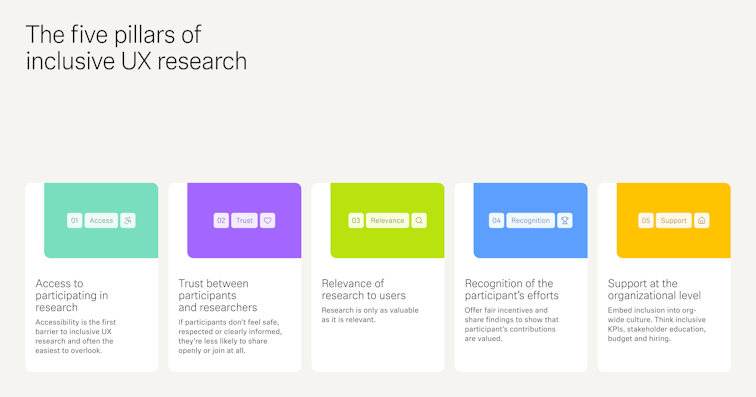
The five pillars of inclusive UX research: access, trust, relevance, recognition, and support
1. Access: to participating in research
Accessibility refers to whether people can physically, cognitively, and technologically take part in a study. That includes everything from being able to load a prototype on their device, to understanding the language used, to navigating a session with or without assistive technology.
It’s the first barrier to inclusive UX research—and often the easiest to overlook. Even if your study is technically 'open to everyone,' participation may still be limited by practical constraints: internet speed, device compatibility, session timing, tool accessibility, or language fluency.
Here’s how you can improve access:
- Support assistive technology: Ensure your research platform supports screen readers, keyboard navigation, and other tools used by people with disabilities.
- Offer alternative formats: Provide options beyond video calls, like unmoderated tasks, audio response, or text-based surveys, to accommodate different user needs. Follow the WCAG (Web Content Accessibility Guidelines), which outlines how to make digital content more accessible to people with disabilities.
- Adapt scheduling: Allow for flexible session times across time zones and life situations (caregivers, shift workers, people with chronic conditions).
- Use inclusive onboarding: Make it easy to understand how to join and participate, even for people unfamiliar with research platforms or English-language interfaces.
- Minimize digital barriers: Test your tools on low-bandwidth connections and older devices. Not everyone has access to the latest tech.
2. Relevance: of your research to users
Relevance means that:
- Your research reflects users’ lived realities
- Users see a reason to care
Too often, relevance is treated as a byproduct—something you hope will happen if your screener’s wide enough or your questions are clear.
If your study doesn’t account for people’s real-world contexts, how they live, work, or access tech, you’ll collect surface-level data at best. This is especially critical when working with underrepresented groups, where assumptions about language, culture, or digital fluency can quickly skew the results.
At the same time, users need to understand why your research matters. What will their feedback change? How will it improve their experience with your product or service? If it’s not clear why their voice matters, the research can feel one-sided, and people may not want to take part.
To highlight and optimize the relevance of your research:
- Involve users early: Co-create research questions or themes with participants or community partners to surface real pain points and priorities.
- Avoid default framing: Don’t assume Western, urban, English-speaking, able-bodied users as the baseline. This shows up in subtle ways, from task instructions to designing and prototype testing.
- Test for real-world scenarios: Focus on how users experience your product within their own context, not ideal conditions. That could mean limited data plans, shared devices, or using your product in a second language.
- Design with cultural sensitivity: Inclusive design (and, by extension, inclusive research) adheres to specific design principles for diversity from the outset. Avoid idioms, symbols, examples, or workflows that assume a shared background. Research tasks should resonate across ethnicity, language, digital accessibility, and user diversity.
Want to see how inclusive research principles translate into product decisions? Our article on inclusive design examples explores how teams have adapted products to reflect diverse user needs and what researchers can learn from those approaches.
3. Trust: between participants and researchers
If participants don’t feel safe, respected, and clearly informed, they’re less likely to share openly or join at all. This is especially true for people from communities that have been historically excluded from research or harmed by biased systems.
To build and maintain trust:
- Be transparent: Clearly explain the purpose of your research, how the data will be used, and what participants can expect. Use plain, inclusive language and always include an option to opt out.
- Respect autonomy and lived experience: Let participants self-identify across categories like gender identity, ethnicity, or disability status. Avoid assumptions or phrasing that reinforces bias in UX research.
- Design for privacy and accessibility: Use tools that are compatible with assistive technology, and allow participants to engage in the way they’re most comfortable, whether that’s written feedback, asynchronous testing, or choosing not to use video.
- Honor contributions: Even if participants are anonymous, treat their input with care. Quote accurately. Don’t paraphrase out of context. Give credit in aggregate findings where appropriate.
“The best you can do is show them you’re open to help... ask them what they need, or if you can meet them where they are.”
Geoffrey Crofte
UX Accessibility Author and Senior UX Lead
Share
4. Recognition: of the participant’s efforts
Too often, participants from marginalized or underserved communities are asked to share their experiences without seeing any follow-through, credit, or clear benefit. This can create research fatigue, skepticism, or a sense that their contribution didn’t matter.
- Offer fair, flexible incentives: Compensate people appropriately for their time, and offer options that suit different preferences or needs. This is especially important for participants with lower socioeconomic status or those taking time away from work or caregiving.
- Make findings accessible: Share back what you’ve learned in a clear, respectful way, whether that’s a summary email, a thank-you note, or a translated insight report. This helps close the loop and reinforces that their voice mattered.
- Reflect their impact: When presenting findings to stakeholders, make space for the language, quotes, and themes that participants shared, especially those that might challenge assumptions or dominant narratives.
- Avoid tokenism: Don’t spotlight a participant or community just to show ‘diversity.’ Recognition means treating all input with care and context, not using it to tick a box.
5. Support: at the organizational level
This fifth pillar was shaped through our conversation with Geoffrey, and highlights how this guide builds on established research by bringing in lived industry experience.
While existing frameworks lay a solid foundation, they often miss a key ingredient: organizational support. Inclusive UX research doesn’t happen in isolation. It needs space, funding, and leadership buy-in to make a difference.
Geoffrey calls this an inclusive mindset at the organizational level—embedding inclusive research into a company’s culture, priorities, and decision-making processes.
“It’s not enough for researchers to ‘do inclusion’ in a corner—the business itself has to value and act on it.”
Geoffrey Crofte
UX Accessibility Author and Senior UX Lead
Share
That means:
- Educating stakeholders about the value of inclusive design and research
- Updating success metrics to include inclusive outcomes
- Weaving inclusion into product strategy, hiring, roadmaps, and budgets
- Empowering teams to challenge bias in tools, processes, and assumptions
Without this kind of cultural shift, inclusive research can feel like a side project—or get ignored altogether.
As Geoffrey explains:
“At Foyer, I’m not afraid to say that some high-level folks lack cultural knowledge and education. And that’s okay—we all have different backgrounds. But that’s why it’s important to empower people, especially designers, to bridge the gap between their knowledge and the diverse expectations of our clients.”
Organizational support is what turns inclusive research from a nice idea into a practice that drives real change.
How to run inclusive user research: From participant recruitment to post-research wrap-ups
Inclusion should be built into every step of the research process. In this section, we look at what inclusive research looks like in practice, with specific considerations for each stage of the research lifecycle.
Recruit inclusively for user research
Inclusive research starts with inclusive recruitment. If the people you speak to don’t reflect the diversity of your users, your insights won’t either. That means being intentional about who you recruit, how you recruit them, and what barriers you may be unknowingly creating.
Here are some key practices:
- Be intentional, and cast a wider net
- Offer flexible, remote sessions
- Compensate fairly
- Rethink personas (but don’t rely on them alone)
✅ Be intentional, and cast a wider net
Start by defining what diversity means for your product. Are you considering a range of abilities, languages, income levels, tech access, or geographic locations? Then recruit accordingly—and leave ample time to get the participants you need.
“Give people more time to respond to your call for participation, so you can build a more representative panel,” Geoffrey says. “And don’t just say everyone’s welcome—speak directly to underrepresented communities and open up diverse channels.”
✅ Offer flexible, remote sessions
Remote research opens the door to people who might be unable to attend in person—those with limited mobility, caregiving responsibilities, rural locations, or social anxiety. Offer flexible scheduling and allow reschedules when needed. Accessibility also means making space for real life.
✅ Compensate fairly
Fair pay is an inclusion issue. Compensation helps remove financial barriers, respects people’s time, and invites broader participation, especially from communities who may be underpaid, underrepresented, or balancing multiple responsibilities.
“Minorities that are left behind are also folks who earn way less than the average. Depending on your country, one hour's participation in a session should be around €50 retribution” Geoffrey notes.
Be clear about the incentive upfront.
✅ Rethink user personas (but don’t rely on them alone)
User personas can help teams build empathy, but they can also reinforce bias if they focus too much on surface traits. Instead, center behavior, context, and access needs. Tools like Jobs-To-Be-Done and Empathy Maps offer richer, more flexible ways to represent users.
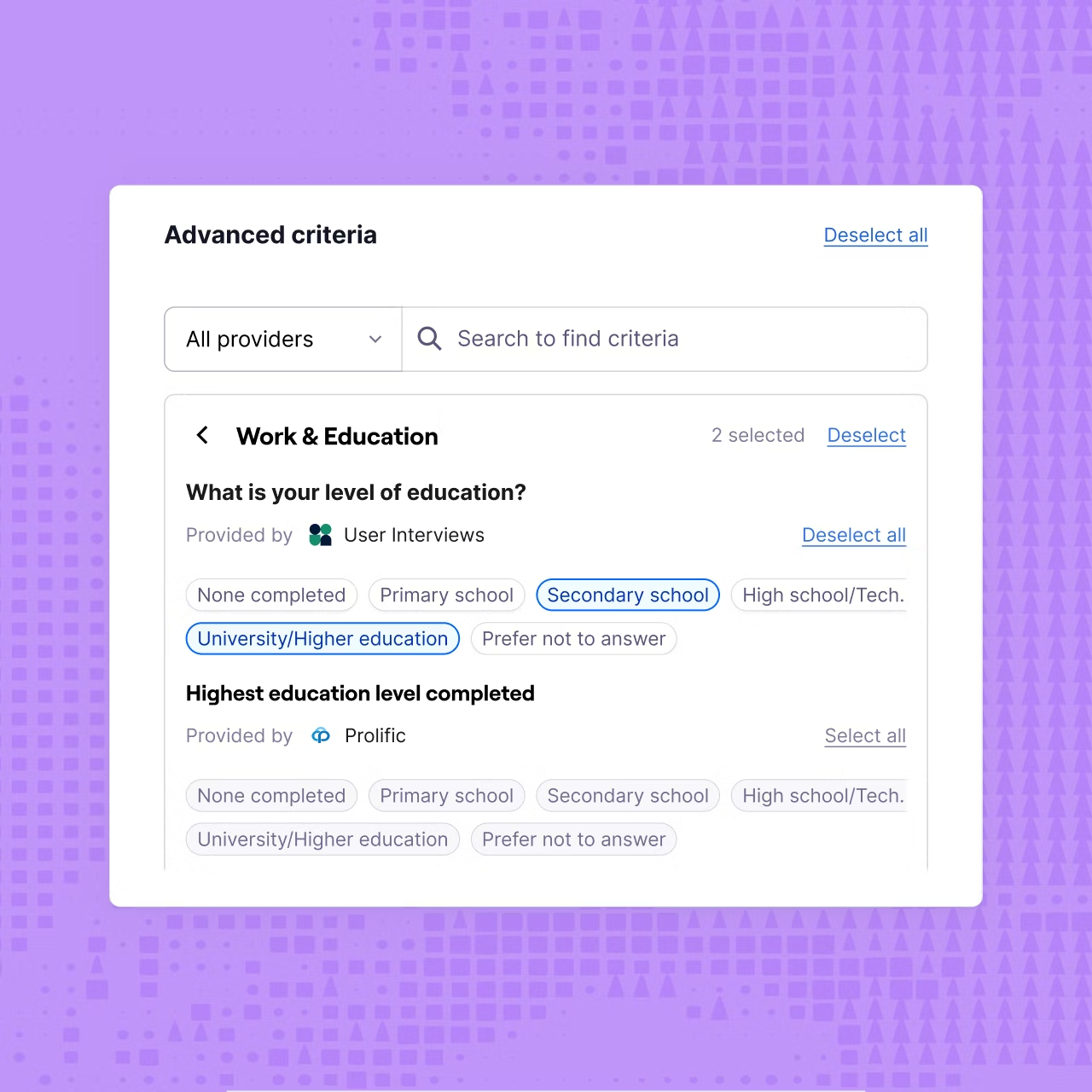
Want to turn these tips into action? Maze Panel gives you access to over 6 million participants across 150+ countries. With 400+ filters and custom screeners, you can recruit people based on very specific needs, like screen reader usage, internet access, device type, or prior experience with similar tools.

Write inclusive research questions and tasks
Your research questions shape the insights you get. You need to write tasks and prompts that don’t confuse, exclude, or bias the way people respond.
That starts with three essentials:
- Plain language
- Assumption-free phrasing
- Clear context
✅ Use plain language when explaining
Plain language means writing in a way that's clear, direct, and easy for everyone to understand, regardless of reading level, language background, or cognitive abilities.
|
Prior to initiating your session, please ensure device compatibility |
Make sure your device works before you start |
|
Navigate to the onboarding module |
Go to the getting started page |
|
Utilize the platform’s advanced filtering functionality to refine your search |
Use filters to narrow your search |
|
Should you encounter any discrepancies, kindly notify the administrator |
If something looks wrong, let us know |
|
Select the appropriate option from the dropdown to proceed |
Choose an option from the list to continue |
✅ Avoid assumptions about participants
Instead of writing one-size-fits-all prompts, design neutral, flexible scenarios. For example:
|
You’re a mom buying groceries online for your kids |
You’re shopping online for someone else in your household |
|
Book a hotel using your laptop |
Book a hotel using any device you’re comfortable with |
|
You’ve just received a raise at work |
You’ve recently decided to increase your monthly budget |
✅ Provide context and a ‘why’
You're asking people to imagine a situation, make decisions, and share feedback based on their own lived experience. A little setup helps a lot.
|
Find the pricing page |
You’re considering using this product and want to check how much it costs |
|
Sign up for a free trial |
You’re interested in trying this product. What’s the sign-up process like? |
|
Edit your profile |
You’ve just changed jobs and want your profile to reflect your new role |
💡Not sure where to start? Discover over 350 questions for your UX research in the Maze Question Bank: our tried-and-tested question repository. Completely free to use, take a look to kickstart your question writing or spark your imagination.
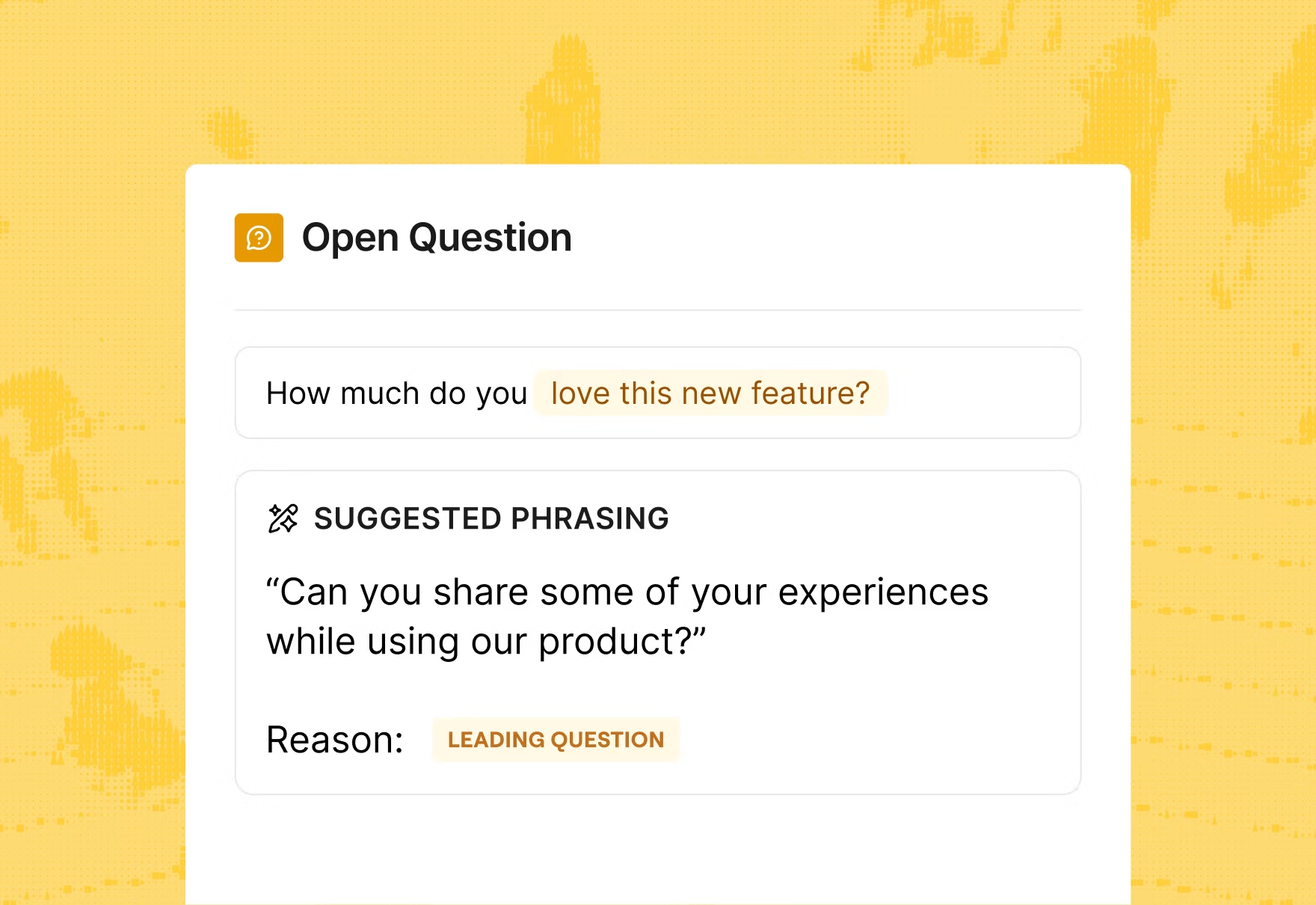
Maze’s Perfect Question feature utilizes AI to identify bias, vagueness, or confusion in your tasks and phrasing, then suggests a clearer, more inclusive version on the spot. Whether you’re running moderated sessions or async surveys, it helps you ask better from the start. And with AI follow-ups, you can trigger contextual, probing questions based on each participant’s response.

Conduct inclusive user research
This is the part most people think of when they hear inclusive research: running the actual sessions, talking to participants, and gathering insights.
At this stage, inclusion means removing barriers that make it harder for people to participate, communicate, or give useful feedback. That includes the format you choose, the tools you use, and how you structure each task.
Here’s how to conduct your research:
- Start with secondary research
- Run accessibility-focused studies
- Weave inclusion into every study
✅ Start with secondary research
Secondary research means using existing data and insights on inclusive product best practices to inform your study before collecting any new feedback.
This can include:
- DEI or accessibility audits
- Industry reports or academic studies
- Customer support tickets or product analytics
- Cultural or regional research related to your users
Doing this early helps you understand the context your users are coming from, spot potential barriers, and avoid asking biased or repetitive questions. It also lets you design focused, relevant tasks so participants aren’t stuck explaining things you could’ve already known.
✅ Run accessibility-focused studies
Generally, usability testing often assumes ideal conditions—fast internet, full vision and hearing, mouse or touch input, and no cognitive or motor barriers. That leaves out a wide range of real user experiences.
To design more inclusively, run dedicated research studies focused on accessible design. This might include:
- Interviews with neurodivergent users
- Surveys about assistive tech, device setups, or environment-related challenges
- Sessions with people using screen readers, voice controls, or keyboard navigation
You can also adapt usability tests to reflect everyday constraints, for example:
- Navigating with one hand
- Completing a task on a shared or older device
- Using your product in bright sunlight or loud spaces
✅ Weave inclusion into every study
You don’t need a separate study just for accessibility or inclusion. Instead, make it part of how you run every research session.
- Include tasks that check for accessibility (e.g., Can users navigate this flow with a keyboard?)
- Ask questions about clarity, comfort, or barriers even if that’s not the main focus
- Let people choose how they participate: video, audio, written, live, or async
This approach helps you spot exclusion earlier, without adding more work for your team or more burden for your users. And it sends a clear message: every voice matters, every time.
Wrap up inclusive research
After the research, be just as intentional about how you analyze, share, and act on insights.
This links directly back to the recognition pillar we discussed earlier. It’s about acknowledging their time, effort, and expertise throughout the process, including at the end.
When wrapping up:
- Provide genuine recognition of participant contribution
- Offer a range of participant compensation options
- Create an open feedback channel
✅ Provide genuine recognition of participant contribution
Say thank you like you mean it. A generic auto-response doesn’t cut it. Make your message personal and clear about the value of their contribution. Even a simple sentence like “We’ll use this feedback to improve onboarding for first-time users” helps participants understand their impact.
✅ Offer a range of incentives
Use simple, flexible options like bank transfers, gift cards, or vouchers—and make sure they’re easy to understand and access. Slow or complex systems send the wrong message, so make sure compensation isn’t an afterthought.
And if your study asks for more time or effort (like diary tasks or follow-up sessions), increase the payment to match. Work with participants to find compensation that’s actually beneficial to them.
✅ Create an open feedback channel
Stay in touch and encourage participants to share their feedback proactively. If their input leads to a product change or design improvement, let them know. Recognition is stronger when people see the results. Offer opt-ins for future studies or research panels. Don’t assume; ask.
These steps build trust and credibility, especially among communities who’ve historically been excluded from product development. And they shift research from being a one-off transaction to part of an ongoing, more equitable relationship.
Need an easy way to stay in touch with participants? Maze Reach helps you build your own research database. It’s like a CRM built for participant management. You can import contacts, segment them by behavior or demographics, and send personalized research invites over time. This makes it easier to stay in touch with underrepresented user groups, track engagement, and avoid over-recruiting the same voices.
Your inclusive research checklist: Before, during, and after
“I try to ask myself if we’re really open to new perspectives, or just looking for people who agree with our assumptions.”
Geoffrey Crofte
UX Accessibility Author and Senior UX Lead
Share
Inclusive research is a practice. And like any practice, it gets better with structure.
This checklist combines practical tips from this guide with questions shared by Geoffrey Crofte, Senior UX Lead Designer at Groupe Foyer. Use it to gut-check your research and design process at every stage—from who you involve, to how you listen, to how you wrap up.
Prioritize inclusion from the get-go
Inclusive UX research is the result of intentional choices: who you reach out to, how you frame your questions, the tools you use, and the mindset you bring.
At Maze, we help teams scale user research without sacrificing depth or representation. Whether you’re recruiting globally, refining your questions with AI, or running unmoderated tests, Maze gives you the tools to make research fast, flexible, and inclusive by default.


Frequently asked questions
What is inclusive user research?
What is inclusive user research?
Inclusive user research is the practice of designing and conducting research in ways that welcome and represent a broad range of people across ability, identity, background, language, and access needs. It means using methods, tools, and environments that allow everyone to participate equitably.
What is an example of inclusive user research?
What is an example of inclusive user research?
Let’s say you’re running usability tests for a job search platform. Instead of recruiting just young professionals in tech hubs, you make space for a wider range: a retired teacher looking for part-time work, a caregiver using a mobile device with assistive tech, and someone job hunting in their second language.
You offer sessions outside typical 9–5 hours, include phone and voice-note feedback options, and write tasks that don’t assume a specific tech setup, income level, or family structure. You also ask participants if anything about the experience felt confusing or exclusionary.
That’s inclusive research with real people, contexts, and effort to meet them where they are.