












In the AI era, competitive advantage hinges on the quality of a company’s decision-making. As execution becomes easier to replicate, companies are increasingly separated not by how fast they build, but by how well they decide what to build in the first place.
That shift is already visible in how the best teams operate.
Across the teams we work with, a clearer alternative to the status quo is emerging. The organizations making the most progress are building a shared, real-time understanding of their customers, market, and competitors that strengthens with every study, conversation, and decision. The impact of this approach shows up in their confidence and in the quality of their biggest bets.
We call this a system of learning. A new way to turn learning into better decisions.
The hidden problem behind most decisions
Organizations generate more customer feedback, research, analytics, and market signals than ever before. In theory, this should lead to better decisions. In practice, there is still a disconnect between what teams learn and what actually shapes their direction. This manifests in a number of ways, but there are a few prominent ones you might recognize in your own team.
Research arrives late to the party
The researchers who have the most impact are the ones who get into the room while a decision is still being shaped—not after the roadmap is finalized. This is rarely what happens in practice. Typically, by the time research is shared, the decision has already been made. The failure mode here is that research becomes a check box. Insights are generated, but they don’t feed back into the strategy, so their impact is limited.
Until now, the solution has been faster research cycles. The system of learning takes a fundamentally different approach by integrating research into decisions when—and where—those decisions are being made. The result is that teams don’t have to choose between velocity and an insights-driven decision-making process.
Assumptions don’t evolve as quickly as reality
At the heart of every decision is an assumption, and assumptions have a shelf life. Customers change. Competitors move. New technologies reshape behavior. Markets rarely stand still for long, and the beliefs that once helped teams move forward can lose relevance just as quickly. The earliest signs often emerge long before they show up in business results: shifts in customer behavior, research patterns, competitor moves, or changing customer expectations.
What makes this difficult is recognizing when the goal posts have moved and which assumptions need to change as a result. The question isn’t whether assumptions expire. It’s how quickly organizations can see it happen.
Learning doesn’t compound over time
Research is in high demand, but much of this information is shared, discussed, and acted on in the moment, only to be quickly buried in dashboards and project folders.
The result is familiar: teams revisit the same questions, repeat the same debates, and make important decisions without drawing on everything they already know.
This wastes time and resources, but the bigger cost is that every decision starts at the same place as the last, instead of each decision creating a more informed foundation for the next.
A system of learning
When we looked at the organizations that consistently adapt and make clearer, confident decisions, a new pattern emerged. These teams aren’t running more research or collecting more information. They’re operating in what feels like a continuous loop by connecting what they believe to what they learn and move forward with. Everything feeds into each other, rather than sitting in separate places.
That loop is what we call a system of learning.
It’s not a research process or a feedback program—it’s a rhythm. It’s the way an organization stays continuously aligned with reality, by making sure learning doesn’t just get captured, but actually shapes what happens next.

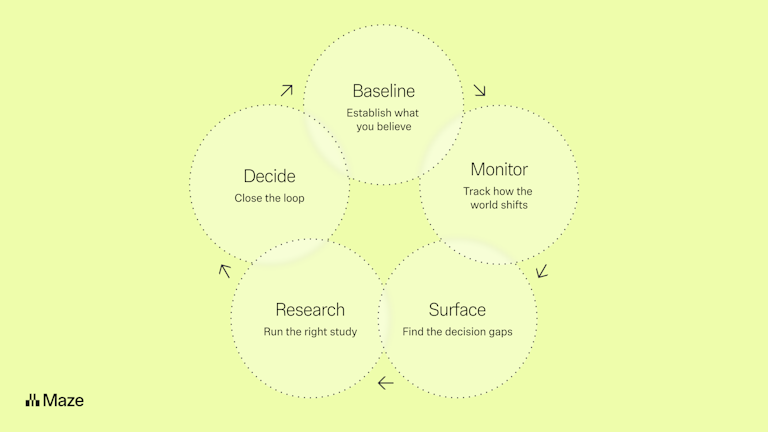
At a practical level, it shows up in five stages:
- Baseline: The current set of assumptions teams are working from and believe today
- Monitor: How those assumptions are tracked as the world outside the organization shifts
- Surface: How teams identify new questions, risks, and decision gaps in day-to-day work
- Research: How those gaps are explored with the right evidence, moment, and people
- Decide: How that learning feeds directly back into strategy, product direction, and decisions
What sets the system of learning apart from how most organizations are conducting research today is that each stage addresses the breakdowns between research and decision-making. The system ensures that research is integrated into decisions while they are still being shaped. It surfaces unknowns and keeps everyone informed as the landscape shifts. The loop strengthens with each cycle. Every piece of learning makes the next decision more informed and better than the last, and over time, that compounds.
What you learn shapes what follows
We're already at a point where building is easier than ever. Execution alone stops being a differentiator, it just creates motion. What separates teams now is whether learning keeps pace with what they’re building or falls behind it.
The teams that will stand out are the ones who make research part of how decisions are made every day—light when it needs to be, deeper when it matters—but always building on what came before. Each insight has somewhere to go, and each decision carries more context than the last. Nothing gets lost in the space between learning and executing.
That’s what we’re building towards at Maze.
A system where research flows through every part of the company, instead of sitting alongside it. And once you start operating like that, the shift is hard to ignore. You don’t just make better decisions in the moment; you build momentum in how you learn.
If you’re building a system of learning today, your decisions won’t sit in isolation anymore, they’ll carry forward. And that changes everything.