








Chapter 4
When and How to Outsource Market Research: A Buying Guide
TL;DR
Market research can be run in-house or with outside support, depending on the scope of the study and the resources your team already has. Running it in-house is a better fit when your team has the research skills, participant access, and time to manage the study from start to finish. Outsourcing is a better fit when you need specialist methods, neutral moderation, access to buyers beyond your own network, or research across multiple markets.
A market research project can be as simple as a survey your team runs in-house, or as advanced as a bespoke market research commissioned from an external provider.
The decision to keep in-house or outsource depends on the scope of the study and the support your team needs. Some projects fit your existing research capabilities, while others require outside expertise or additional resources.
In this chapter, we look at how to:
- Decide between in-house vs outsourced market research
- Compare traditional agencies with AI-native research platforms
- Evaluate providers on cost, speed, methodology, and participant quality
Let’s start with the research your team may already be equipped to run in-house.
When in-house research is enough
In-house research works best for repeatable studies such as message tests, concept tests, customer surveys, or moderated interviews. It’s a good fit when your team already knows how to design and run that type of study, can recruit the right participants, and has time to analyze the results properly.
In-house research is usually a good option when:
- You need to answer a focused question: This could be testing messaging, comparing concepts, or gathering feedback on a specific product or campaign idea
- Your team knows how to run the study: You already know how to design the survey or interview, recruit participants, avoid cognitive bias, and analyze the results
- You can recruit the right research participants: Your team already has access to the customers, prospects, or target buyers the study needs
- Your team has enough time to run the study: You can manage recruitment, conduct interviews or surveys, review responses, analyze the findings, and report the results without delaying other priorities
- You run the same type of research frequently: Recurring surveys, brand trackers, or concept tests are easier to keep in-house once your team has a repeatable process and uses automation
Once a study falls outside what your team can confidently run in-house, an external research partner may be a better fit.
When it's worth commissioning a study
Commissioning a study is a better fit when you need to reach buyers outside your own network, get candid feedback on sensitive topics like pricing or positioning, or coordinate research across multiple markets or audience segments.
High-stakes decisions: Repositioning, pricing, category bets
High-stakes decisions are where outsourcing market research can be especially helpful. Bringing in expert support can help ensure that your studies lead to reliable, decision-driving outcomes. Generally speaking, you want to commission a study when the decision requires audiences, expertise, or research methods your team can’t easily support in-house.
For example:
- Entering a new market or category: You may need to recruit buyers beyond your existing customer base and compare how different segments or markets define the category.
- Repositioning your brand: An external research partner can help run brand perception research to see which attributes customers, prospects, and competitors’ customers already associate with your brand, and where those perceptions differ. That gives you a baseline before testing a new position.
- Changing pricing: Pricing studies may require specialist methods, careful sample design, and enough responses to compare willingness to pay across customer groups.
What outside expertise actually adds to market research
Outside expertise can improve four key parts of the study:
- Study design: A research partner can help turn a business question into the right study design. That includes choosing the right method, defining the sample, setting participant criteria, writing screeners, and deciding what needs to be compared.
- Participant recruitment: External support can help you recruit outside your existing customer base. That might include competitor customers, senior decision-makers, buyers in a new market, or participants who meet specific behavioral criteria. A provider can build screeners, set quotas, verify participants, and recruit the same audience criteria across several markets or segments.
- Data collection and quality assurance: Running the study means ensuring the research is carried out consistently. For interviews, that includes following the discussion guide, probing when an answer needs more detail, and avoiding leading questions. For surveys, it can include monitoring quotas, screening out low-quality responses, checking completion patterns, and fixing fieldwork issues before they affect the final dataset.
- Analysis: External researchers can code interview responses, compare themes across buyer groups, cross-tab survey results, and look for differences between markets or segments. The analysis should provide actionable insights that answer the original business question—for example, which positioning resonates with each audience, where brand perceptions differ, or how purchase intent changes across price points.
You don’t need to outsource every part of the study. You might only need help recruiting participants, or you might commission an outsourced team to design, run, and analyze the entire project.
Outsourcing studies: Agency vs AI-native
When you outsource a market research study, you can work with a traditional research agency or use an AI-native research platform.
Traditional agencies are researcher-led and typically involve hands-on support throughout the project, while AI-native platforms use automation to support the research workflow, from study execution to analysis.
What you choose depends on:
- How quickly you need results
- How much budget you have
- How much researcher support you need
- How complex or customized the study needs to be
- Whether you’re commissioning a one-off study or running it regularly
Let’s look at how those factors differ between traditional agencies and AI-native research platforms.
Traditional agencies: Bespoke and researcher-led, but slow and expensive
Traditional research agencies are a good fit for studies that need a custom research design and involvement from experienced researchers. You provide the brief, and the agency manages the methodology, recruitment, fieldwork, analysis, and final report.
For example, if you’re repositioning a brand across the US, UK, and Germany, an agency can recruit the same buyer profiles in each market, adapt the discussion guide for local audiences, run the interviews in different languages, and compare the findings across countries. Agencies are also useful for research that depends on experienced human moderation, such as interviews, focus groups, or ethnographic studies.
But this level of hands-on support comes with a few drawbacks:
- Longer timelines: Each stage depends on people being available to scope the study, recruit participants, run sessions, review the data, and prepare the final report, so projects can take several weeks to complete
- Higher costs: Agency fees usually include recruitment, moderator time, analysis, reporting, and project management, which can add up significantly
- Limited flexibility once the study starts: Adding a new audience, market, or line of questioning brings changes to the research plan, participant sample, timeline, and budget
- More setup for recurring research: If you run the same study every quarter or after each launch, you may need to repeat the briefing, scoping, and coordination process each time
If those repeated handoffs, timelines, and costs don’t fit the way your team works, you may want to look at tools that automate the research process.
DIY and AI-only tools: Fast and cost-effective, with research oversight
If opting not to outsource, researchers can use AI to plan market research studies, draft questions, moderate interviews, analyze responses, and prepare findings.
AI research tools can also give teams more flexibility and improve operational efficiency. You can launch another study, adjust questions, or repeat the same research without starting a new agency engagement each time.
To get the most from that flexibility, teams still need researcher oversight throughout the process:
- Methodology still needs oversight: Your team decides on the right method, sample, questions, and study structure
- AI outputs need review: Researchers can validate summaries, themes, and recommendations against the original responses
- Human moderation still has a role: AI can handle structured interviews at scale, while an experienced human moderator can step in for complex or sensitive conversations
- Research expertise still matters: Our 2026 Future of User Research report found that participants see human judgment as essential for interpreting nuance and emotion (82%), making ethical decisions (80%), and framing the right research questions (76%)
Market research vendor evaluation: What to look for
Whether you’re comparing a traditional research agency or an AI-native platform, assess both against the same core criteria. Look at how they design the research, recruit participants, maintain data security, deliver research results, and price the work.
Methodology rigor
Methodology rigor comes down to whether the provider can design the study around the question you need to answer. The method, sample, question order, moderation approach, and analysis all need to work together.
With a traditional agency, look at the agency’s track record and previous work. Ask about their experience with the research method, audience, and market you’re studying. Also check whether the agency handles the research itself or outsources parts of the fieldwork or analysis.
With an AI-native platform, look at how much control researchers have over the study design and how the AI handles questions, follow-ups, and analysis.
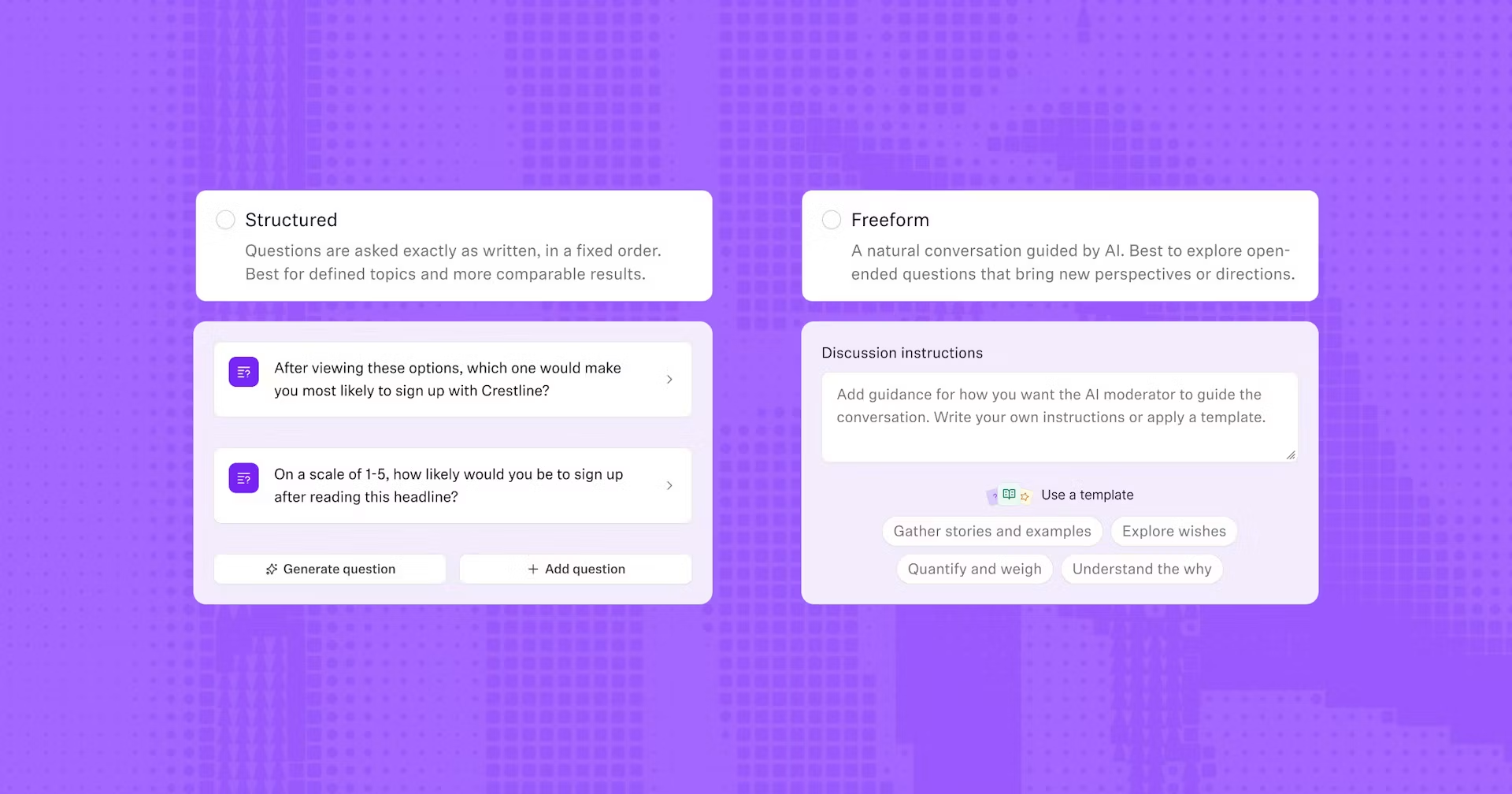
Maze’s AI moderator, for example, lets researchers define learning goals, choose between structured and freeform discussions, control discussion depth, and set instructions for how follow-up questions are handled. Maze also evaluates AI-moderated conversations against 25 quality metrics designed to check research quality and consistency.

For market research studies, also check whether the platform supports the question formats and stimuli your methodology requires. Maze’s AI for market research capabilities include visual stimuli for testing images and video. For preference studies, you can use ranking to compare a smaller set of options, or MaxDiff to identify which claims, benefits, or messages matter most across a larger list.
Respondent authenticity and sourcing
There are several ways to recruit research participants. You can invite your own customers or prospects, recruit through a research panel, or use a provider that sources participants on your behalf. What matters is that you know where respondents come from and whether they match the audience you intend to study.
With a traditional agency, ask how participants are recruited and screened. Find out whether the agency uses its own network, external panels, specialist recruiters, or a combination. For niche B2B audiences, check how it verifies criteria such as job role, seniority, organization size, and buying experience.
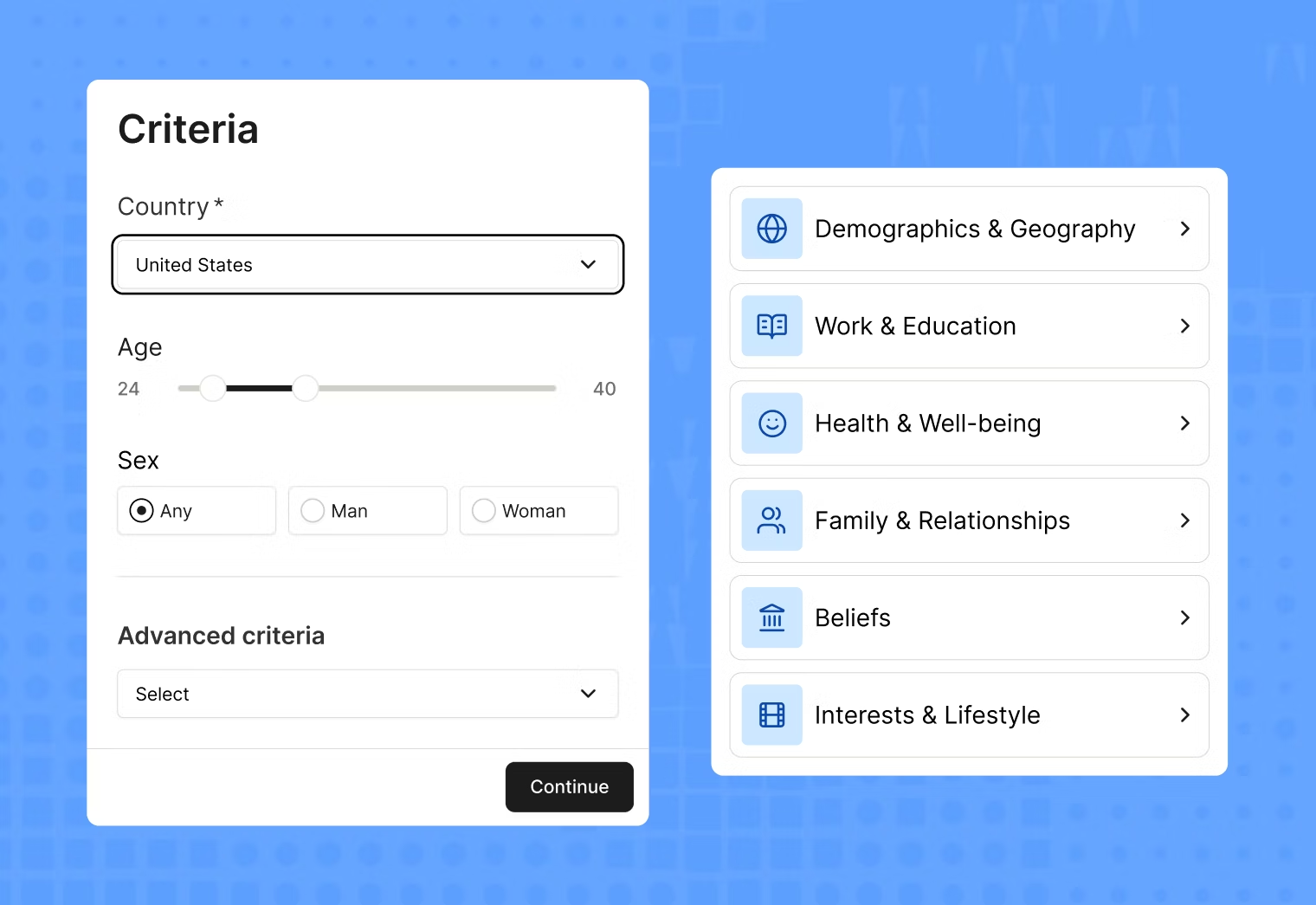
With an AI-native platform, look at the targeting and screening controls available to your team. Maze’s panel, for example, uses third-party recruitment providers and lets teams target B2B and B2C participants across 150+ countries. For unmoderated studies, teams can use 400+ targeting filters, including job title, seniority, industry, company size, demographics, technology use, and other criteria. Custom screener questions can then qualify participants against requirements that standard filters don’t cover.
You can also review individual participant responses and report participants whose answers are rushed, copied, generated by bots, or inconsistent with the targeting criteria.

Some AI-native research providers also offer synthetic users. They are AI-generated representations of users rather than people who have taken part in the study. They can help teams explore early hypotheses or test a research setup, but their responses shouldn’t be treated as direct feedback from real buyers.
Data privacy and AI governance
Market research may involve interview recordings, transcripts, survey responses, and participant information. So before you share that data with a provider, look at:
- Model training: Find out whether your research data is used to train or fine-tune the provider’s AI models
- Third-party AI providers: Check which external models or services process your data and what information is sent to them
- Data retention: Confirm how long research data stays with the platform and its AI providers after processing
- Access and controls: Check whether admins can limit AI features, control who can access research data, and disable AI processing when needed
- Security and compliance: Review the provider’s data processing agreement, subprocessor list, security certifications, and compliance with regulations such as GDPR
With a traditional agency, review its data processing agreement, cybersecurity practices, subcontractors, access controls, and retention policies. If the agency uses external transcription, analysis, or AI tools, ask which services receive your research data.
With an AI-native platform, also check whether your data is used to train AI models, which third-party models process it, and how long those providers retain it.
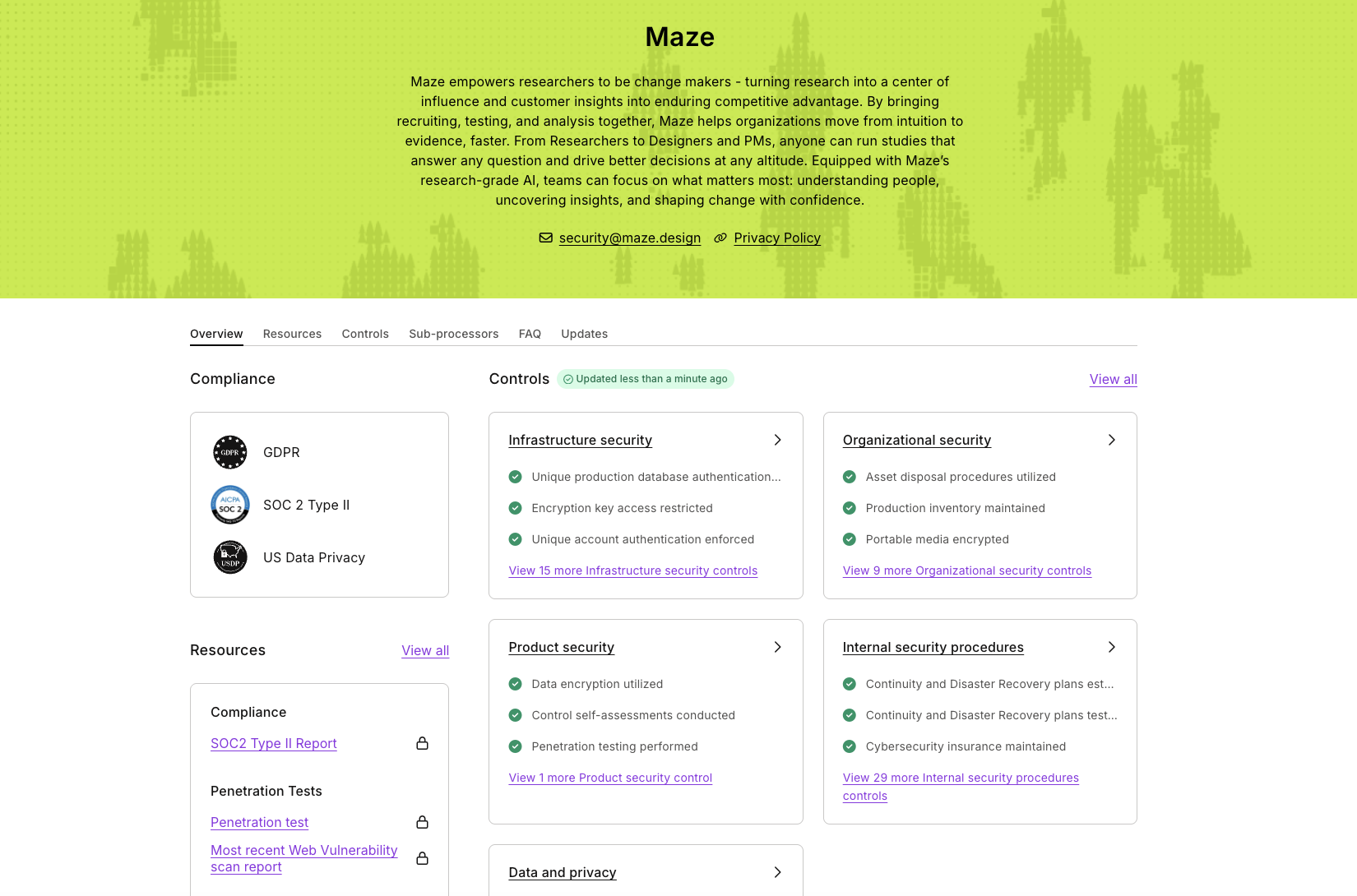
Maze, for example, doesn’t use customer data to train AI models. Its AI features use third-party providers including OpenAI, Anthropic through Amazon Bedrock, Google Gemini, and Deepgram. Enterprise teams can also disable all AI features or control access to individual AI capabilities from the admin settings.
Maze is also SOC 2 Type II certified and GDPR compliant, with its subprocessors and data-processing terms documented separately. You can visit the Maze Trust Center to review its security controls, compliance documentation, subprocessors, and data-processing practices.

Turnaround time
Turnaround time tells you how long it will take to go from a ready-to-launch study to findings your team can use. This is important when you need to make time-sensitive decisions, such as a product launch, pricing change, campaign, or repositioning project.
With a traditional agency, ask how long each stage will take. Recruitment availability, moderator schedules, analysis, and reporting can extend the timeline, especially for multi-market or highly customized studies.
With an AI-native platform, check which stages of the research run automatically and which still depend on participant recruitment or researcher review.
Maze’s AI study builder is an AI-powered research assistant that turns a research goal into a structured study. It recommends the methodology, drafts questions, adds relevant study blocks, and configures key settings. Researchers can then review and refine the study before launch.

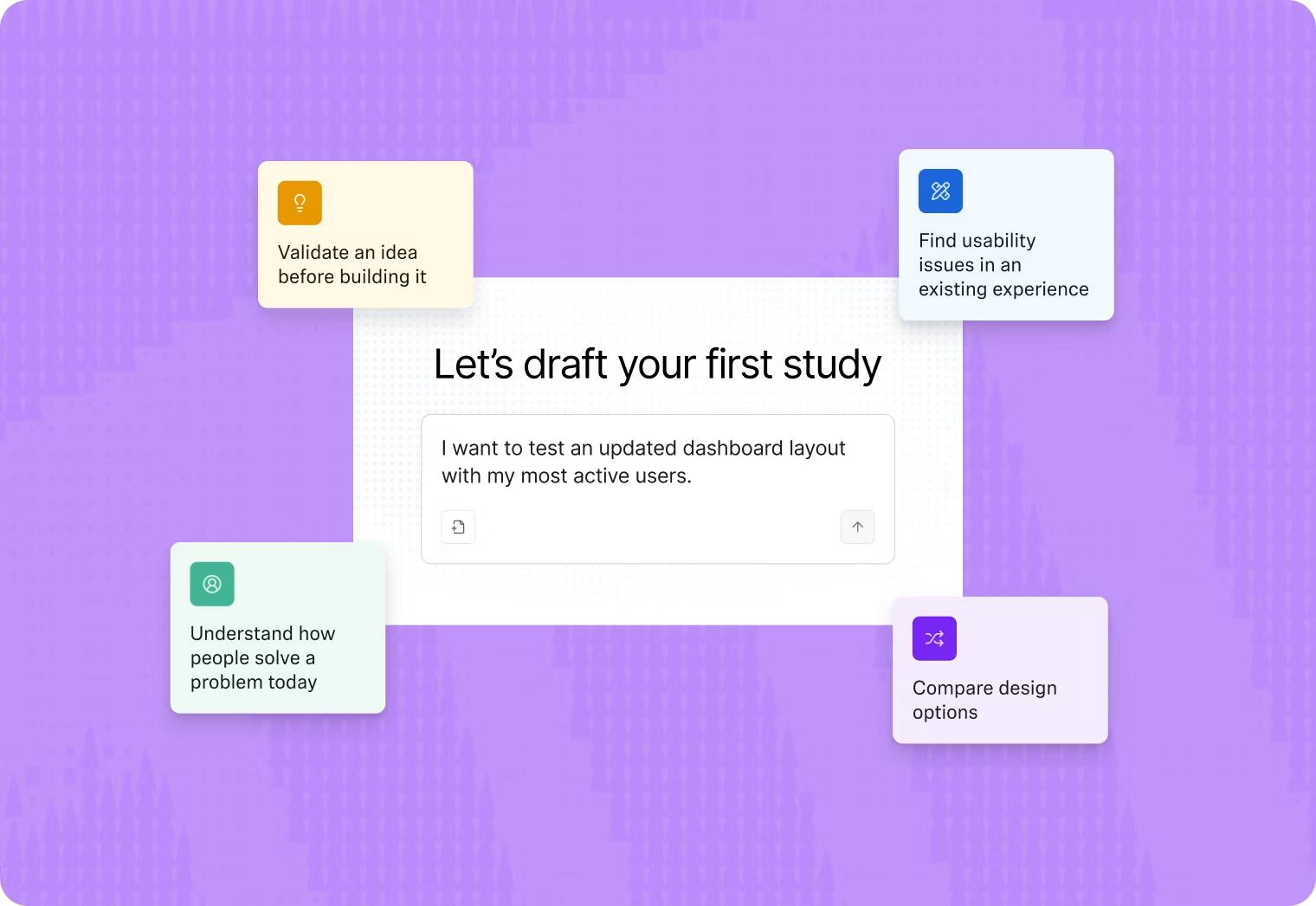
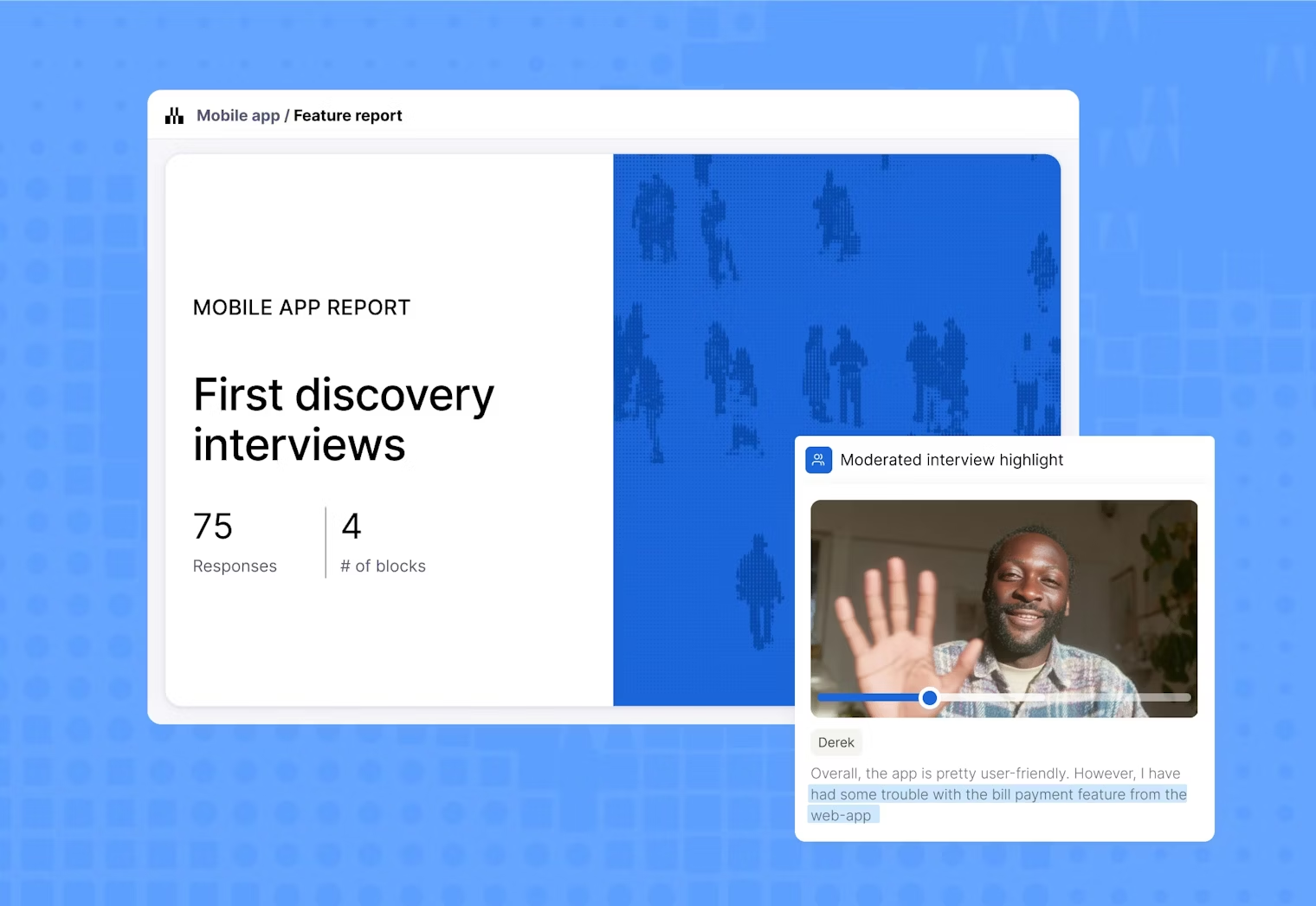
For market researchers using Maze this can reduce the time spent setting up a study. Maze also generates UX reports as responses come in and updates them as new data is collected. For unmoderated studies, AI-powered thematic summaries and open-response analysis become available once the study collects at least 10 open-text responses.

Pricing transparency
Pricing should show what it will cost to run the research you have planned, including any costs beyond the initial quote or subscription.
Check how the provider charges for:
- Testing the platform: Check whether a free plan or trial gives you access to the research methods, AI features, and reporting tools you need
- Platform access: Understand what the subscription covers, including seats, studies, number of responses, interview hours, and any limits tied to each plan
- Onboarding and migration: Find out whether setup support is included and whether moving existing studies, participant data, or research repositories costs extra
- AI usage: Check which features use credits, how credits are calculated, whether they expire, and what happens when you use more than what your plan includes
- Participant recruitment: Confirm whether panel recruitment, screening, and participant incentives are included in the quoted price or billed separately
- Extra usage: Consider the cost of adding more seats, participants, studies, storage, or AI credits once you go beyond the plan limits
With a traditional agency, check what the project fee includes. Recruitment, participant incentives, moderation, translation, analysis, reporting, project management, and additional markets may be charged separately.
With an AI-native platform, look at subscription limits and usage-based charges. Check the cost of seats, studies, responses, interview hours, AI credits, participant recruitment, incentives, onboarding, and additional usage.
Use your expected research volume to compare providers. If you plan to run 20 interviews every month, for example, work out what those interviews will cost once AI usage, recruitment, and participant incentives are included.
What a bespoke market research study includes
A bespoke market research study is designed around a specific business question, audience, and decision. It may focus on one research area or combine several methods. Common examples include win-loss research, category and buyer perception studies, and pricing research.
Win-loss stories
A win-loss study evaluates buyer decisions to show what repeatedly influences deal outcomes. Findings can reveal whether product fit, pricing, positioning, competitor differences, or the sales process shaped the result. The study can also include anonymized buyer quotes and comparisons across won, lost, and no-decision deals.
Category and buyer perception research
A bespoke perception study can answer two related questions. Category perception research looks at how buyers define the market, which brands they group together, and what they expect from companies in that category. Brand perception research looks at how those same buyers see your brand, including the qualities they associate with it and how they compare it with competitors.
Pricing research
Pricing research helps you understand what buyers are willing to pay and how demand changes at different price points. A bespoke study might use Gabor-Granger to test purchase intent at specific prices, Van Westendorp to identify an acceptable price range, or conjoint analysis to measure which product features buyers value enough to pay more for.
What to put in your market research brief
A market research brief gives the research team the context they need to design the study. Start with the business problem, what you need to learn, and the constraints the study needs to work within.
It should include:
- Background and business context: Explain what prompted the research. Include relevant information about the product, market, customers, competitors, or recent changes that the research team needs to understand.
- The decision the research will inform: State what your team expects to change once the research is complete, such as entering a market, changing pricing, repositioning the brand, or launching a new offer.
- Research objectives and questions: List the specific questions the study needs to answer. Keep these tied to the business decision rather than starting with a broad goal such as ‘understand our customers’.
- Target audience and market: Define who you need to hear from and where. Include relevant criteria such as customer status, job role, seniority, industry, company size, geography, or buying behavior.
- What you already know: Share existing customer research, sales data, previous studies, market reports, or other information that could inform the study.
- Method preferences or requirements: Note any methods you want to use, such as interviews or surveys, along with any sample-size or market requirements. If you’re unsure, leave room for the research team to recommend the best approach.
- Deliverables and reporting needs: Specify what you need at the end of the study. This could be a research report, presentation, raw data, interview recordings, transcripts, or findings broken down by audience or market.
- Timeline and key deadlines: State when you need the findings and what business milestone is driving that date, like product launch, leadership meeting, or pricing decisions.
You don’t need to describe every research decision in the brief. Once the scope is clear, you can decide which parts need outside support and which your team can run in-house.
Get started in-house with Maze
Not every market research project needs to be outsourced. If your team has the research skills and capacity to run the study, Maze gives you the tools to manage more of the work in-house.
Start with the Maze AI study builder to turn your research goal into a structured study with questions, task blocks, and follow-ups. Maze also supports AI for market research capabilities, including visual stimuli for testing images and video, ranking for comparing preferences, and MaxDiff for identifying which claims, benefits, or messages participants value most.
You can invite participants through in-product prompts or recruit them through the Maze panel, then run surveys, interview studies, and AI-moderated interviews in one platform.
Maze AI can help summarize responses, identify themes, and turn the findings into reports your team can review and share—giving you one workflow for planning, running, and analyzing market research in-house.



FAQs about outsourcing market research
Should market research be in-house, agency-led, or outsourced to an AI-native platform?
Should market research be in-house, agency-led, or outsourced to an AI-native platform?
The best way to run a market research study depends on how complex your study is, your timeline and budget, and whether you can reach the right participants. Keep it in-house when your team has the skills and capacity, use an agency for highly customized research that needs hands-on support, or choose an AI-native platform when you want to manage the study yourself with AI support across the workflow.
How long does a bespoke market research study take?
How long does a bespoke market research study take?
A bespoke market research study typically takes several weeks, but the timeline depends on the type of study. A win-loss study may take around four to six weeks, while a brand perception study can take several weeks to recruit the right sample, collect responses, and compare findings across markets or audience groups.
What does a market research study typically cost?
What does a market research study typically cost?
The cost of a market research study depends mainly on the audience you need to recruit, sample size, research method, number of markets, and depth of analysis. For traditional agency-led B2B market research, 2026 pricing data for B2B market research puts many projects between $18,000 and $100,000, with multi-market or mixed-method studies easily reaching $100,000 or more. AI-native platforms use a different pricing model, so costs may depend on the plan, participant recruitment, AI usage, interview hours, and research volume.
What should be in a brief before commissioning a study?
What should be in a brief before commissioning a study?
Your market research brief should cover the business problem, the decision the research needs to inform, research questions, target audience, markets or segments, existing research, required deliverables, budget, and timeline.